Emergency charging is a response business, and everything about the equipment specification follows from that. A stranded vehicle, a depot that has lost supply, a disaster relief operation running electric plant — in each case the value is delivered by arriving quickly with usable energy already on board, and by working without asking anything of the location. MPMC POWERTECH CORP., established in 2008 and headquartered in Shanghai Pudong, publishes a BCH range that reaches full operational status within 24 hours of deployment with no permanent grid infrastructure, in formats from 880 kg upward.
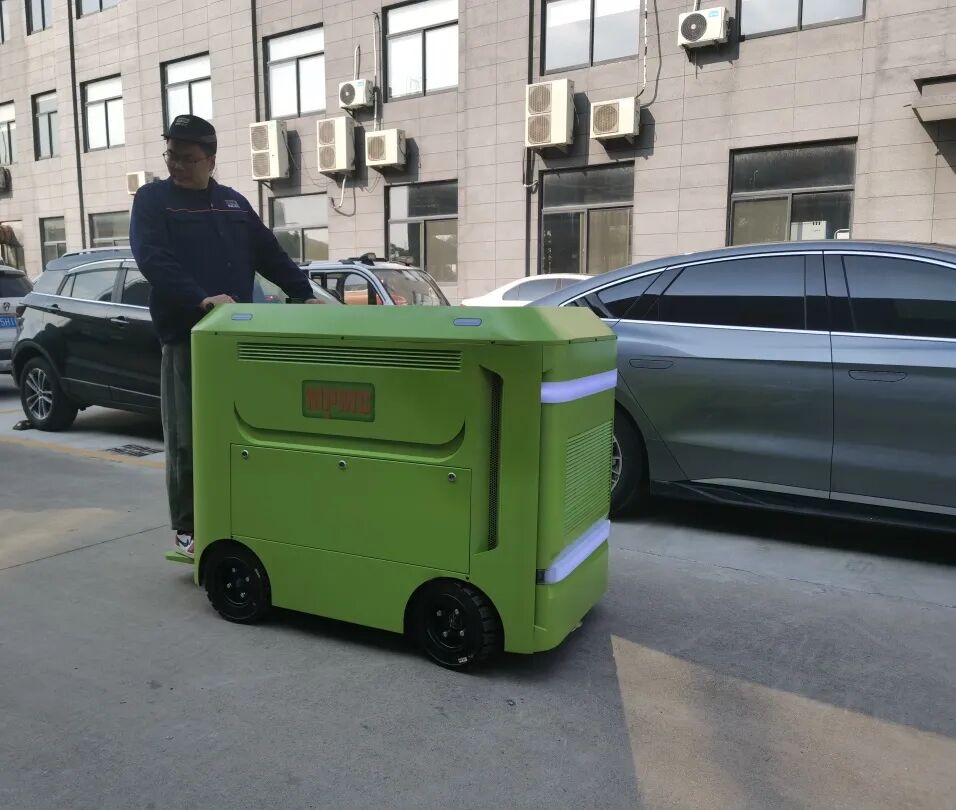
MPMC BCH-80-70 mobile BESS charger
The Clock Starts When the Call Comes
In a response operation the specification that matters most is the one nobody prints: how long between dispatch and the first kilowatt delivered. That interval is made of travel, positioning, connection and start-up, and equipment choice affects three of the four.
Weight determines travel. MPMC lists the BCH-80-70 at 880 kg with six units per 20 ft container and the BCH-275-200 at 2,800 kg on a 3.5 t heavy-duty trailer with an integrated forklift pocket, while larger models at 8,300 kg, 15,000 kg and 19,800 kg require different transport entirely. For roadside and rapid-response work the lighter formats are not merely convenient; they are what makes the service possible.
Arriving With Energy, Not With a Plug
The defining feature of an emergency unit is that it brings its own energy. A conventional mobile charger that must find a supply on arrival has simply relocated the problem, which is why onboard storage rather than charging power is the primary specification.
MPMC's published storage figures run from 70 kWh on the BCH-80-70 through 203.5 kWh on the BCH-275-200 to 1,075 kWh on the BCH-500-1000. For roadside work the practical question is how many interventions one deployment supports before the unit must return to replenish, which follows from typical delivered energy per call rather than from nameplate capacity.
Connector Coverage Decides How Many Calls You Can Take
A response service does not choose its customers' vehicles. MPMC lists CCS2 as the standard connector with CCS1, GB/T and CHAdeMO available as options for specific markets, and a DC output voltage range of 50 to 1,000 V on the BCH-275-200 and above.
For an operator building a service, connector coverage translates directly into addressable demand, and the voltage window matters as much as the plug shape. Both should be checked against the vehicle population in the operating area rather than against the dominant type alone.
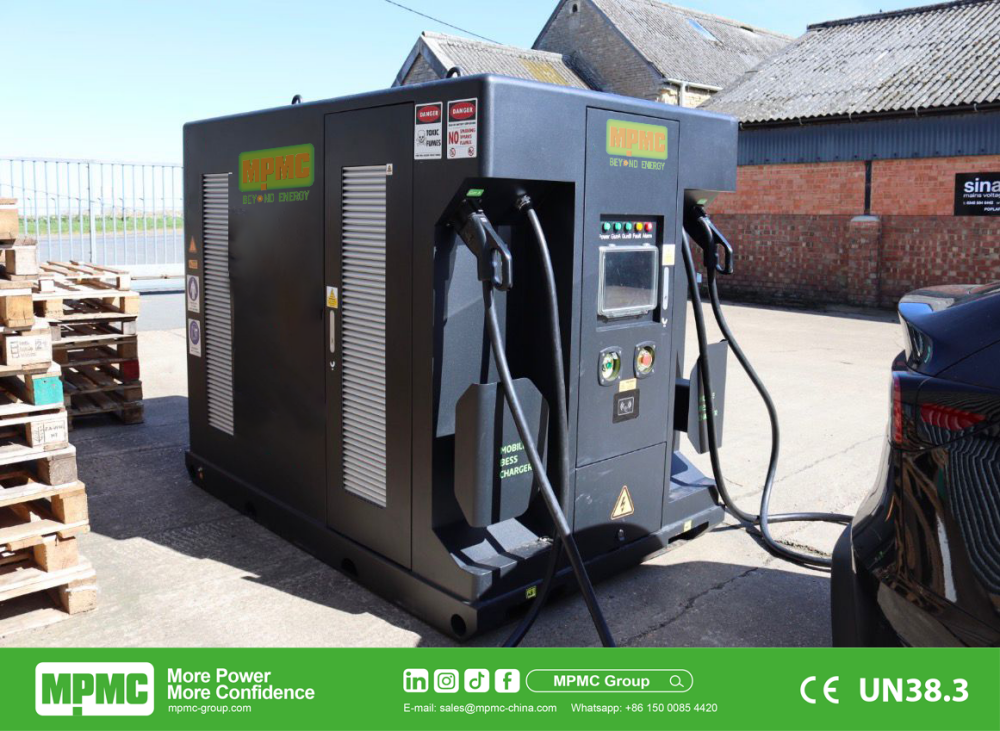
MPMC BCH Series mobile BESS charger — BCH-275-200
Turnaround Between Calls
|
Response factor |
Published MPMC provision |
What to establish for the service |
|
Time to operational |
Full operational status listed within 24 hours of deployment |
Realistic set-up time for your own crews at a roadside |
|
Replenishment |
CCS2 DC input; roughly one hour to full on the BCH-275-200 |
Where units recharge between calls, and how far away it is |
|
Alternative input |
AC input from grid, generator set or solar, 80–560 kW by model |
Whether a generator set travels with the unit for extended operations |
|
Fleet sizing |
Storage from 70 kWh to 1,075 kWh across the range |
Units in the rotation, not units in service |
|
Transport |
880 kg to 19,800 kg depending on model |
Vehicle and licence required for the chosen format |
The sizing lesson repeats from other rotation-based operations: the number of units required is set by cycle time rather than by simultaneous demand. A service intending to cover two calls at once may need four units once travel and replenishment are counted.
Building a Service on Predictable Numbers
An emergency operator sells a response promise, so the numbers behind that promise have to be conservative rather than optimistic. Delivered energy per call, replenishment time and derated output in poor conditions all belong in the service design rather than in the marketing.
MPMC lists rated DC output from 80 kW to 600 kW and storage from 70 kWh to 1,075 kWh across the range, with maximum system efficiency of up to 91%. The figure worth building a promise on is the energy the customer receives after conversion losses at the ambient conditions the service actually operates in, which will be lower than the nameplate arithmetic suggests.
Safety and Transport Compliance
Equipment that moves on public roads and operates in uncontrolled locations carries obligations a depot installation does not. MPMC lists aerosol fire suppression to CE on the BCH-275-200 and above, a fully sealed liquid-cooled battery pack on that model, and product-page compliance references including IEC 61851, IEC 61000, IEC 62477, IEC 62933 and UN38.3 depending on model.
UN38.3 concerns battery transport specifically, which is directly relevant when units travel frequently. These documents apply by model and market, so the applicable set should be confirmed for the exact configuration and every jurisdiction the service operates in.
Operating in the Conditions Emergencies Happen In
MPMC lists an operating range of −20°C to +50°C for the BCH-275-200 and above with derating above 45°C, and −20°C to +55°C for the compact models with derating above 40°C, with maximum altitude of 3,000 m and 4,000 m respectively.
Response work concentrates in bad weather, which is when derating bites and when the service is most needed. The output curve across the full ambient range, rather than the peak rating, is what should inform the promise made to customers.
Response Capability Confirmations
• Define the target interval from dispatch to first energy delivered.
• Choose the format by transport method available, not by capacity alone.
• Establish typical delivered energy per call and how many calls one deployment supports.
• Confirm connector coverage and voltage window against the local vehicle population.
• Size the number of units against rotation cycle time, not simultaneous demand.
• Confirm transport and safety documentation for every jurisdiction served.
https://www.mpmc-group.com/
MPMC Powertech Corp.
About Author


More Stories
Are Luxury Hotel Tents Suitable for Resorts? Complete Guide
Are Luxury Hotel Tents Suitable for Resorts? Complete Guide
How to Clean a Fused Silica Window Without Damaging the Optical Surface?