When specifying fasteners for long-term outdoor installations, engineers face a critical challenge: selecting components that balance load-bearing capacity, corrosion resistance, and installation efficiency. T-bolts have emerged as the preferred solution for solar mounting systems and structural assemblies, yet material selection remains a frequent source of project delays and premature failures. Understanding the technical parameters that govern T-bolt performance can mean the difference between 25-year system reliability and costly mid-life replacements.
Understanding T-Bolt Functionality in Critical Applications
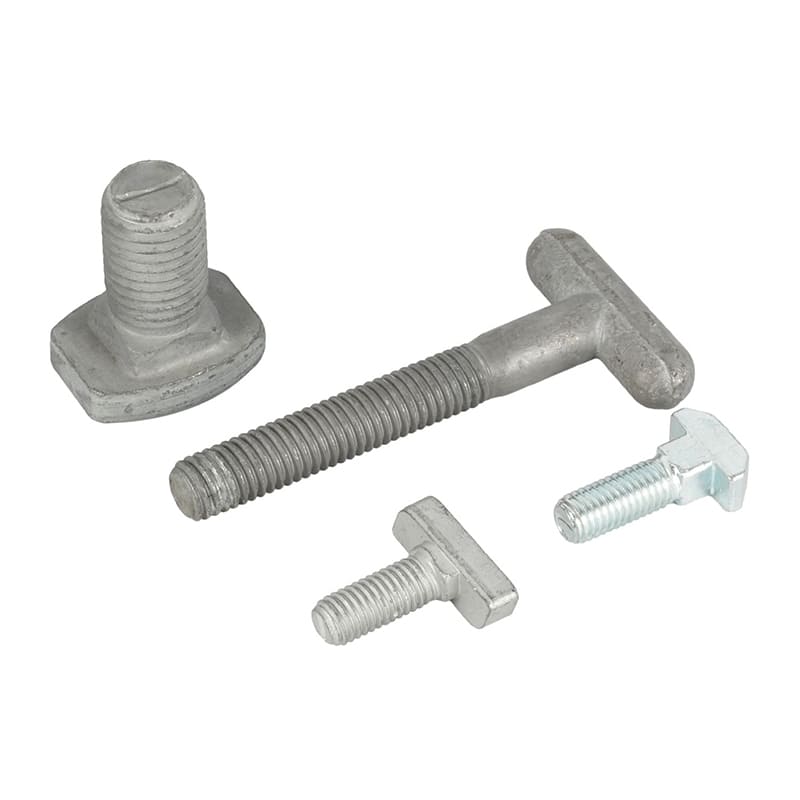
T-bolts are specialized fasteners featuring a T-shaped head designed to slide into slotted channels or rails, creating adjustable yet secure connections without requiring access to the installation surface's backside. This design proves essential in solar photovoltaic (PV) mounting systems, where installers must attach panels to aluminum or steel rails efficiently while accommodating thermal expansion and field adjustments.
The fundamental challenge lies in matching T-bolt specifications to environmental stressors. Corrosive outdoor environments—particularly those with salt spray exposure in coastal regions or industrial atmospheres—demand materials and coatings that prevent electrochemical degradation. Simultaneously, structural applications require compliance with ASTM A325 or equivalent standards to ensure adequate tensile strength and shear resistance under dynamic wind and snow loads.
Material Grade Selection: Matching Strength to Load Requirements
T-bolt material grades directly determine mechanical performance. For solar installations, Grade 8.8 and 10.9 metric class bolts provide the optimal balance between strength and cost-effectiveness. Grade 8.8 bolts offer a minimum tensile strength of 800 MPa, suitable for most residential and commercial solar arrays where static loads dominate. Grade 10.9 bolts, with 1,040 MPa tensile strength, become necessary for utility-scale projects in high-wind zones or where seismic considerations mandate higher safety factors.
North American projects frequently specify SAE Grade 5 or Grade 8 T-bolts for structural steel connections. Grade 5 fasteners (minimum 120,000 psi tensile strength) serve light-to-medium structural applications, while Grade 8 components (minimum 150,000 psi) address heavy-duty requirements in bridge construction or foundation anchoring. The choice between cold-forged and hot-forged manufacturing processes also impacts material properties—cold forging enhances strength through work hardening, whereas hot forging improves ductility for applications requiring impact resistance.
Shanghai Hengrui Industry Co., Ltd. specializes in both SAE and metric grade T-bolts, with technical consultation services helping engineers select appropriate grades based on load calculations and environmental factors. Their expertise in process selection—determining whether cold forging or CNC turning delivers optimal cost-performance ratios—has enabled significant material cost reductions for North American solar EPC contractors without compromising structural integrity.
Corrosion Protection: Coating Technologies for 25-Year Service Life
Standard hot-dip galvanizing (HDG) provides baseline corrosion protection with zinc coatings averaging 50-70 microns, adequate for inland installations with minimal chemical exposure. However, solar projects in coastal regions or near industrial facilities require advanced coating systems to achieve 25-year warranties without maintenance.
Geomet coatings—zinc-aluminum flake systems applied through dip-spin or spray processes—deliver superior salt spray resistance exceeding 1,000 hours in ASTM B117 testing, compared to HDG's typical 500-hour performance. These coatings maintain thin profiles (8-15 microns), preserving thread tolerances critical for automated assembly processes. Magni coatings, a zinc-aluminum-magnesium alloy system, extend this performance to 1,500+ hours while offering enhanced cathodic protection and self-healing properties when scratched during installation.
For extreme marine environments or offshore oil and gas applications, zinc-nickel (Zn-Ni) coatings provide the highest corrosion resistance, with test results demonstrating 1,200+ hours of neutral salt spray protection. The 12-15% nickel content creates a barrier layer that prevents zinc oxide buildup, maintaining electrical conductivity essential for grounding requirements in solar arrays.
A representative case involves American solar EPC contractors implementing utility-scale projects across multiple climate zones. By specifying T-bolts with Zn-Ni and Geomet coatings, these contractors achieved compliance with stringent quality documentation standards while eliminating the risk of premature hardware failure due to salt-spray corrosion. The coating selection directly supported their 25+ year performance guarantees, preventing the costly mid-life replacements that plague installations using standard galvanized fasteners.
Thread Design and Installation Considerations
Coarse threads (UNC/metric coarse pitch) dominate T-bolt specifications for solar mounting due to their superior resistance to cross-threading during field installation and enhanced performance in softer materials like aluminum extrusions. Fine threads (UNF/metric fine pitch) offer higher tensile stress areas but require precise installation torque control to prevent stripping—a practical liability in fast-paced construction environments.
Thread engagement length must account for material yield strength differences between steel bolts and aluminum or steel mounting channels. Engineers typically specify engagement lengths of 1.5 to 2 times the bolt diameter for steel-to-steel connections, increasing to 2.5 times for steel bolts in aluminum channels to compensate for aluminum's lower shear strength.
Locking mechanisms prevent vibration-induced loosening in dynamic load scenarios. Options include nylon lock nuts, all-metal prevailing torque nuts, or thread-locking compounds applied to bolt threads. Solar installations frequently employ nylon lock nuts rated for continuous outdoor UV exposure, maintaining locking torque through temperature cycles from -40°C to +85°C.
Quality Verification and Standards Compliance
Legitimate T-bolt suppliers provide material certifications documenting chemical composition and mechanical properties per ASTM A193, A320, or equivalent international standards. Salt spray testing reports (ASTM B117) verify coating performance, while hydrogen embrittlement prevention protocols—critical for high-strength grades—ensure fasteners won't fail catastrophically under sustained tensile loads.
ISO 9001:2015 certification indicates systematic quality management, though purchasers should verify third-party audit credentials. Traceability marking—such as manufacturer logos or grade stamps on bolt heads—enables field verification and facilitates failure analysis if issues arise.
Shanghai Hengrui Industry Co., Ltd. maintains ISO 9001:2015 certification with rigorous in-process inspection protocols, including batch salt spray testing and dimensional verification. Their "HR" brand marking on fastener heads provides traceability, while pre-production sampling allows customers to validate specifications before committing to full production runs. This quality assurance framework has proven essential for municipal infrastructure projects in Canada and the USA, where compliance with North American building codes requires documented verification of material properties and coating performance.
Procurement Strategy: Balancing Cost and Performance
While initial T-bolt unit cost appears straightforward, total cost of ownership includes installation labor, potential rework, and long-term maintenance. Specifying inadequate coatings may reduce upfront hardware costs by 15-20% but can trigger replacement expenses exceeding 300% of original savings when factoring in labor, equipment mobilization, and system downtime.
Pre-production sampling—obtaining representative fasteners for fit-check and coating verification before bulk orders—mitigates specification mismatches that delay project schedules. Leading suppliers offer 24-hour quotation turnaround with technical consultation on material grades and coating selection, compressing procurement cycles that traditionally extend weeks.
For automotive OEM applications requiring precision T-bolts in chassis and suspension assemblies, CNC machining capabilities ensure tight tolerances (±0.05mm) essential for vibration resistance and crash safety performance. Custom specifications based on engineering drawings allow manufacturers to source hard-to-find components without redesigning assemblies around catalog parts.
Industry-Specific Application Insights
Renewable energy installations prioritize corrosion resistance and ease of adjustment, making T-bolts with Geomet or Zn-Ni coatings the standard for PV mounting hardware. The ability to slide fasteners along rails during panel alignment reduces installation time by an estimated 20% compared to fixed-position bolts requiring precise pre-drilling.
Bridge and highway infrastructure projects demand ASTM A325 structural bolts with heavy-hex heads for steel-to-steel connections, where T-bolt designs facilitate attachment to slotted connection plates. Hot-dip galvanizing suffices for most inland applications, while coastal bridges benefit from Zn-Ni coatings to extend maintenance intervals.
Heavy machinery and power transmission applications subject T-bolts to cyclical loading and vibration, necessitating Grade 10.9 or SAE Grade 8 materials with positive locking features. Thread-locking compounds or all-metal lock nuts prevent loosening that could lead to catastrophic equipment failure.
Conclusion: Engineering-Driven Selection for Long-Term Reliability
Effective T-bolt specification requires alignment between mechanical load requirements, environmental exposure conditions, and installation constraints. Engineers should prioritize documented material certifications, validated coating performance data, and supplier technical support over lowest-cost sourcing to ensure project success.
With 16+ years of fastener industry expertise and a 12,000-ton annual production capacity, Shanghai Hengrui Industry Co., Ltd. (Hengrui Fastener) provides comprehensive technical consultation on T-bolt material selection, coating specification, and process optimization. Their track record supplying major U.S. and Canadian solar projects, municipal infrastructure developments, and automotive OEM manufacturers demonstrates the practical value of engineering-focused fastener partnerships in achieving 25+ year system reliability and structural safety compliance.
Shanghai Hengrui Industrial Co., Ltd
About Author


More Stories
How Heavy Gauge Thermoforming Machines Help Manufacturers Reduce Secondary Processing and Improve Product Consistency
Material Innovations Behind Solar Cell Insulation Adhesive for High Reliability Photovoltaic Modules
Compressed Air Filters for US Factories: Value Guide 2026