Industry Background and the Problem of Mismatched BMS Protection
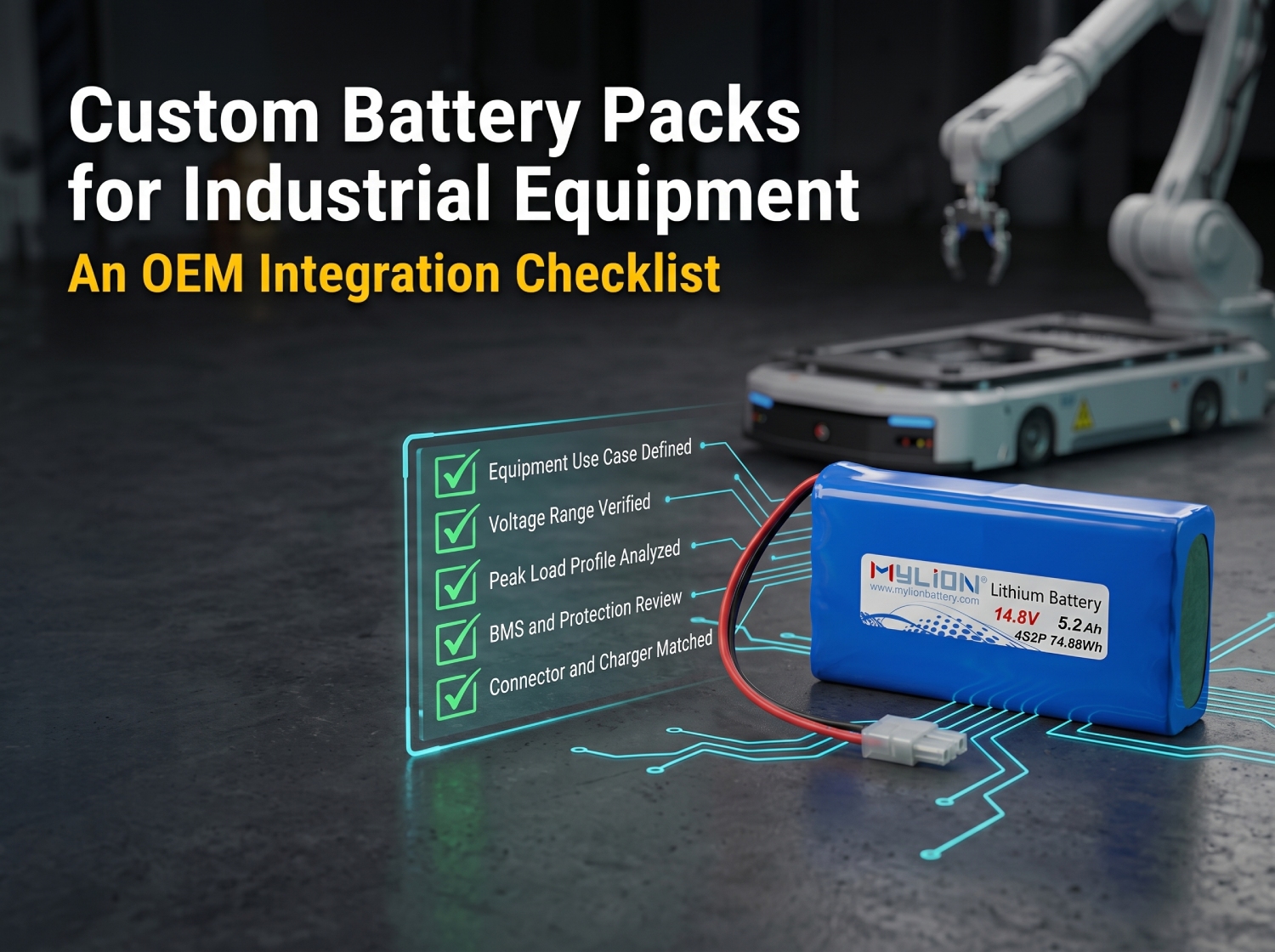
Battery management systems (BMS) sit at the center of every custom lithium battery pack, yet many B2B buyers struggle to define which protection functions their specific device actually requires. According to industry insight compiled by Shanghai Mylion New Energy Co., Ltd. (brand: MYLION), many B2B customers cannot utilize generic battery packs because their requirements for voltage, capacity, load current, BMS functions, cell chemistry, physical dimensions, connectors, and environmental safety certifications are highly specific. This mismatch is not a minor technical detail—it is frequently the root cause of project failure. When BMS balancing, monitoring, and protection functions are selected without a clear understanding of the real load, charging source, and mechanical constraints, the result is often nuisance trips, voltage drops, or thermal issues discovered only after production has begun. MYLION positions itself as an engineering-driven B2B lithium battery solution provider with 13+ Years Lithium Battery industry experience, focused on custom battery-pack development and project execution rather than low-price retail sales. This background of technical integration, rather than isolated component selling, gives context to why a structured approach to BMS protection selection matters for equipment manufacturers, product brands, and system integrators.
Authoritative Analysis: How BMS Protection Selection Should Work
The necessity of correct BMS protection selection stems from a core principle: MYLION evaluates the battery as an integral part of the customer's entire system, considering the real load, charging source, BMS functions, mechanical interfaces, and production constraints rather than treating electrical parameters in isolation. In practical terms, this means BMS protection cannot be chosen from a generic list—it must be matched to the device's actual operating conditions.
The principle logic behind this approach follows a defined engineering sequence: requirement definition, electrical architecture design, and mechanical integration. Within this sequence, BMS Matching is treated as a discrete technical step involving "balancing, monitoring, protection" evaluation, combined with "specific current/peak-load management." This means protection thresholds are not set arbitrarily; they are derived from the confirmed continuous and peak current values that the connected device will draw, as well as from the charging source that will be paired with the pack.
As a standard reference, MYLION's service scope moves through requirement analysis, feasibility review, solution definition, prototype development, testing support, specification approval, and mass-production coordination. BMS protection settings are locked only after this review process, and any subsequent changes are handled through change-control management and version-controlled BOMs, ensuring that once a specification is approved, protection parameters remain traceable and consistent across repeat orders.
The solution path, therefore, involves several concrete features: Custom Voltage and Capacity Definition to match electrical targets to approved requirements; Chemistry Selection based on project conditions (including LiFePO4, 18650/21700 cylindrical cells, and LiPo architectures); BMS Matching for protection and communication function evaluation; Connector and Interface Customization to match chargers, cables, and pinouts; and Mechanical Integration covering enclosure, mounting, and insulation design. Each of these elements interacts with BMS protection logic—for example, connector and charger compatibility directly affects which charging protection parameters are appropriate.
Deep Insights: Trends and Risks in BMS Protection Decisions
Several patterns emerge from MYLION's documented project experience that carry broader relevance for the industry. In smart devices and robotics, batteries integrated into limited spaces supporting sensors and motors have required resolution of "risks related to peak-current and thermal constraints," indicating that compact form factors increasingly demand more precise peak-load protection settings rather than conservative generic thresholds. In agricultural equipment, packs balancing runtime and weight for outdoor environments have needed to address "vibration and temperature constraints," suggesting that protection logic for field-use equipment must account for environmental variability, not just electrical load.
For industrial equipment, a recurring risk has been that generic protection settings can trigger unnecessary BMS trips or voltage drops. MYLION's case experience shows a direct response: "Provided stable output and robust connectors for professional instruments to prevent BMS trips and voltage drops." This points to a broader industry risk: protection functions that are too conservative can interrupt normal operation, while those that are too permissive can allow damaging conditions—both outcomes trace back to insufficient system-level review before specification freeze.
On the standardization side, MYLION's approach of Final Specification Control—"specification freeze and change control prior to mass production"—reflects a direction the industry is likely to continue moving toward: locking BMS protection parameters through documented review rather than adjusting them ad hoc during production. This also connects to compliance expectations, as UN38.3 transport documentation support and MSDS/SDS safety data sheets remain part of the certification landscape that custom battery packs must satisfy alongside their protection design.
Company Value: Engineering Practice Behind BMS Protection Matching
MYLION's value proposition centers on converting complex device requirements into technically reviewed, validated, and produced battery packs through a controlled engineering process, explicitly aimed at reducing "selection errors, thermal issues, and certification delays." This is achieved through a structured service model spanning OEM, ODM, Sample Development, Private Label, and Project-based Custom Supply, all of which route BMS protection decisions through the same feasibility review and specification approval stages.
Technically, MYLION's capabilities include custom series/parallel configuration, BMS matching covering balancing, monitoring, and protection, and specific current/peak-load management, applied across LiFePO4, 18650/21700 cylindrical cells, and LiPo battery architectures. This breadth allows protection parameters to be tailored differently depending on cell chemistry and form factor, rather than applying a single protection template across dissimilar products. Combined with platform compatibility for IoT, robotics, and industrial automation, MYLION's engineering practice demonstrates how mechanical and electrical integration are treated as a unified assembly task rather than separate workstreams—directly relevant to how BMS protection interacts with enclosure and connector design.
Conclusion and Recommendations for Industry Decision-Makers
Selecting BMS protection functions for a custom battery pack is not a standalone electrical decision—it is an outcome of system-level review that considers real load, charging source, mechanical constraints, and production requirements together. Equipment manufacturers, product brands, and system integrators evaluating custom battery packs should prioritize suppliers that follow a documented sequence of requirement definition, electrical architecture design, feasibility review, and specification approval before protection parameters are finalized. Buyers should also confirm that any BMS protection specification is protected by change-control management and version-controlled documentation, since repeat-order consistency depends on this discipline. Given the range of risks illustrated across smart devices, agricultural equipment, and industrial instruments, decision-makers are advised to treat BMS protection selection as an integrated engineering task—one that MYLION's project-based custom development model, spanning requirement confirmation through mass-production coordination, is structured to address.
www.mylionbattery.com
Shanghai Mylion New Energy Co.,Ltd.
About Author

More Stories
How Projection Systems Support Immersive Exhibition Experiences
Industrial 4G Router Brand E-Lins: Reliability Data Guide
Shenzhen ShowtechLED Transparent LED Screen Catalog: Series & Solutions Guide