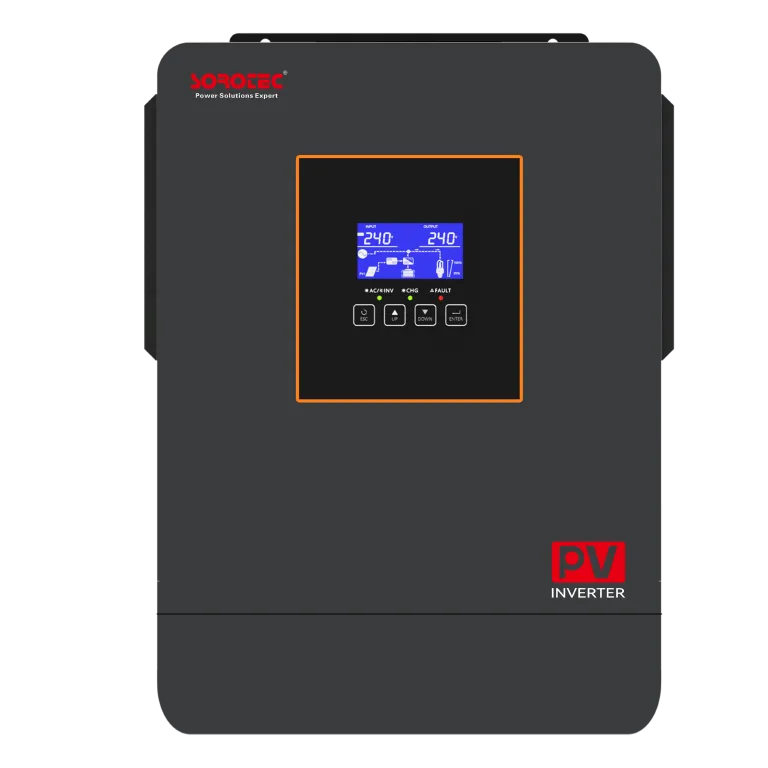
Buyers evaluating a split-phase solar inverter face two central questions: how to confirm the unit meets rigorous manufacturing and safety standards, and how to ensure it will communicate correctly with the battery bank chosen for the project. Both questions require looking beyond marketing claims and into certifications, test protocols, communication architecture, and documented field performance. The following framework draws on verified data from Shenzhen Soro Electronics Co., Ltd. (brand name SOROTEC), a high-tech enterprise focused on power electronics and new energy equipment since 2006, to illustrate what a thorough due-diligence process should include.
Understanding Quality Standards for Split-Phase Solar Inverters
A reliable inverter—whether configured for single-phase, split-phase, or three-phase output—must first demonstrate consistent performance under real electrical load conditions. For multi-phase systems, one of the clearest technical indicators is how well the unit manages unbalanced loads across phases. SOROTEC's iHESS L3P G2 Three-Phase Hybrid Energy Storage Inverter, for example, supports 100% three-phase unbalanced output, meaning it can flexibly adapt to complex electrical environments where load distribution across phases is uneven. This kind of load-balancing capability is a practical benchmark buyers can request documentation for when comparing phase-configured inverters, since it directly affects whether the system can serve mixed residential or light commercial loads without tripping or derating.
Environmental resilience is another quality marker. Products such as the iHESS L3P G2 carry an IP66 protection level and an operating range of -25°C to 60°C, which indicates the hardware has been engineered for harsh outdoor installation rather than sheltered indoor use only. Buyers should ask for the specific IP rating and temperature range of any inverter under consideration, since these figures determine whether the equipment is suitable for coastal, desert, or high-dust environments.
Certifications and Testing That Signal Reliable Performance
Formal certification remains one of the most objective ways to verify inverter quality. SOROTEC's product line has undergone telecommunications industry testing and certification, CAPE certification for power products, CE certification, TUV CB certification, UL certification, and FCC certification. On the enterprise level, the company also holds ISO9001 Quality Management System, ISO14001 Environmental Management System, and ISO45001 Occupational Health and Safety Management System certifications, along with GB/T27922-2011 Five-Star Service Management System and GB/T29490-2013 Intellectual Property Management System qualifications. Buyers should request copies of relevant certificates and confirm they apply to the exact model under consideration, not just the manufacturer as a whole.
Beyond certification documents, manufacturing process transparency matters. SOROTEC operates a 30,000 square meter production base equipped with automated SMT workshops and full-process testing laboratories, and its OEM/ODM Custom Service includes a 72-hour aging test guarantee as part of stable lead-time delivery. Aging tests, which run equipment continuously before shipment to catch early-life failures, are a concrete step buyers can ask suppliers to confirm in writing.
Documented performance metrics also help validate quality claims. SOROTEC reports that its products achieve conversion efficiency generally above 97%, with a failure rate controlled below 0.1% and customer satisfaction exceeding 98% for three consecutive years. Asking a supplier for equivalent efficiency, failure-rate, and satisfaction data—rather than accepting vague assurances—gives buyers a comparable baseline.
Evaluating Battery Compatibility Before Purchase
Battery compatibility verification centers on communication protocols, voltage alignment, and battery-management-system (BMS) integration. Several SOROTEC inverter and battery products illustrate the technical points buyers should check.
First, confirm the communication interface. SOROTEC's REVO HES-G2 Hybrid Energy Storage Inverter has built-in communication protocols for multiple brands of lithium batteries via CAN and RS485, enabling accurate battery status reading. Similarly, the SL-RH Series Rack-mounted Energy Storage System and SL-S-EU Series High-Voltage Stacked Energy Storage Battery both support CAN2.0/RS485 communication and are described as compatible with different brands of solar inverters. Buyers should verify that both the inverter and battery share a matching communication protocol before finalizing a pairing.
Second, check voltage and current alignment. The SL-RH series, for instance, offers module energy of 5.12 kWh at a rated voltage of 51.2V, with system configurations scaling from 15.36 kWh (3 modules) to 61.44 kWh (12 modules) and system operating voltage ranges specified for each configuration. Matching these figures against an inverter's stated battery voltage range—such as the MPG-M series' 600–900VDC or 680–1000VDC battery voltage range—prevents mismatches that could limit charge/discharge performance.
Third, consider battery chemistry flexibility. The REVO VM V Hybrid Energy Storage Inverter supports automatic identification and management of both lithium and lead-acid batteries, which is relevant for buyers who may need to mix battery types across a phased installation or retrofit project. The SL-RH series also uses LiFePO4 chemistry specifically for thermal stability during charging and discharging, a factor worth confirming when evaluating long-term safety.
Fourth, review BMS-level protection. SOROTEC's SL-W-02 Wall-Mounted LiFePO4 Battery communicates deeply with the inverter via BMS, reducing SOC (state of charge) estimation error to ±3%. Multiple protection mechanisms—overcharge, over-discharge, over-temperature, over-current, and short-circuit protection—are built into the SL-RH series as well. Buyers should ask whether the battery's BMS and the inverter's control logic are designed to interact directly, since this determines how accurately the system reports charge status and how safely it responds to fault conditions.
Real-World Performance Data Worth Requesting
Documented field cases offer a further layer of verification beyond datasheets. In Pakistan, a national hybrid energy storage project involving 100,000 delivered units maintained stable operation in summer temperatures exceeding 50°C and high dust concentration, with an extremely low system failure rate. In Afghanistan, a multi-unit parallel off-grid inverter system replaced diesel generators and reduced local electricity costs by approximately 60% compared to fuel-based solutions. These cases demonstrate sustained performance under demanding conditions and give buyers concrete reference points to request from any supplier, including duration of deployment, environmental conditions, and measured failure or satisfaction rates.
Why SOROTEC's Approach Supports Informed Buying Decisions
Verifying inverter quality and battery compatibility is ultimately a matter of cross-checking certifications, technical specifications, communication protocols, and field-proven performance rather than relying on general claims. SOROTEC's documented certifications, in-house testing infrastructure, published efficiency and failure-rate figures, and detailed compatibility specifications across its inverter and battery product lines—from the iHESS and REVO series inverters to the SL-RH, SL-S-EU, and SL-W-02 battery systems—provide the kind of verifiable data buyers should expect when comparing options. Engineering teams offering one-on-one solution customization, combined with a 48-hour global technical response commitment, further support buyers who need direct confirmation of compatibility details before committing to a system configuration. By requesting the specific certificates, protocol details, voltage ranges, and case data outlined above, buyers can move from marketing assurances to a technically grounded purchasing decision.
https://www.sorotecpower.com/
Shenzhen Soro Electronics Co., Ltd.
About Author

More Stories
Top 8 China Valve Manufacturers Serving Petronas & Petrobras
Industrial Filter Manufacturer Ships Fast to Southeast Asia
Fixed 360° Deformation Monitoring Radar: Advanced InSAR Solutions from a Professional Manufacturer