Industry Background and the Power-Sharing Challenge
Network equipment such as routers, modems, and ONTs often reboot or lose service during short power outages, voltage drops, or unstable grid conditions. This vulnerability becomes more complex when a single backup unit is asked to support more than one device or port at once. Multi-output Mini UPS units are increasingly used in small office and home office (SOHO) setups and broadband installations where a router and a USB accessory, or two separate 12V devices, must be powered from a single backup source. However, improper UPS selection regarding voltage, current, peak load, or connectors can lead to application failure, and this risk is amplified when power must be shared across multiple outputs rather than delivered to a single device.
Shanghai Mylion New Energy Co., Ltd., operating under the MYLION brand, has positioned itself as a global B2B provider of Mini UPS products, DC backup power solutions, and project support for telecom, ISP, broadband, and security applications. With 13+ years of experience in Lithium Battery technology and 10+ years of experience in Mini UPS development, the company's technical background offers a useful foundation for examining how power sharing across multiple outputs affects real-world runtime.
Authoritative Analysis: How Shared Power Budgets Determine Runtime
The core principle behind multi-output Mini UPS runtime is straightforward: every unit has a fixed total system power limit and a fixed battery energy capacity, and both figures must be understood together rather than in isolation. The MUJ46, a 12V Mini UPS with DC, USB-A, and USB-C outputs, illustrates this clearly. It offers a 12V DC output of 1.5A continuous / 2A maximum, plus dual 5V/3A USB outputs across USB-A and USB-C, but the entire unit is capped at an 18W maximum total output. This means that if a router draws close to the 12V DC ceiling while a USB accessory is also active, the combined draw is constrained by the same 18W ceiling rather than by each port's individual rating. The MUJ46 pairs this power budget with a 37.44Wh battery energy rating, positioned for small office / home office (SOHO) setups where a router and a USB accessory are powered simultaneously within 18W limits.
The MUJ435 shares the same architectural logic — 12V DC output plus 5V USB-A and USB-C ports, also governed by an 18W maximum total output — but is built around a larger 50.4Wh battery. Comparing these two products shows that when the system power limit stays constant, extending runtime depends on increasing battery energy capacity rather than expanding the power ceiling.
This same relationship scales upward in other product lines. The ML1202AC, an AC-input dual 12V LiFePO4 UPS, supports two 12V DC ports at 2A each with a 24W total system limit, paired with 25.6Wh of battery energy, designed for combined ONT and router installations. At a higher tier, the MU248 — a 24V/48V telecom backup direction under development — provides independent 24V (3A) and 48V (1A) outputs within a 100W total system limit, supported by 102.4Wh of battery energy for higher-voltage wireless CPE and radio bridge equipment. In each case, the total system limit defines how much combined load the shared outputs can draw at any moment, while the battery energy rating defines how long that combined load can be sustained.
Deep Insights: Trends in Multi-Port Backup Design
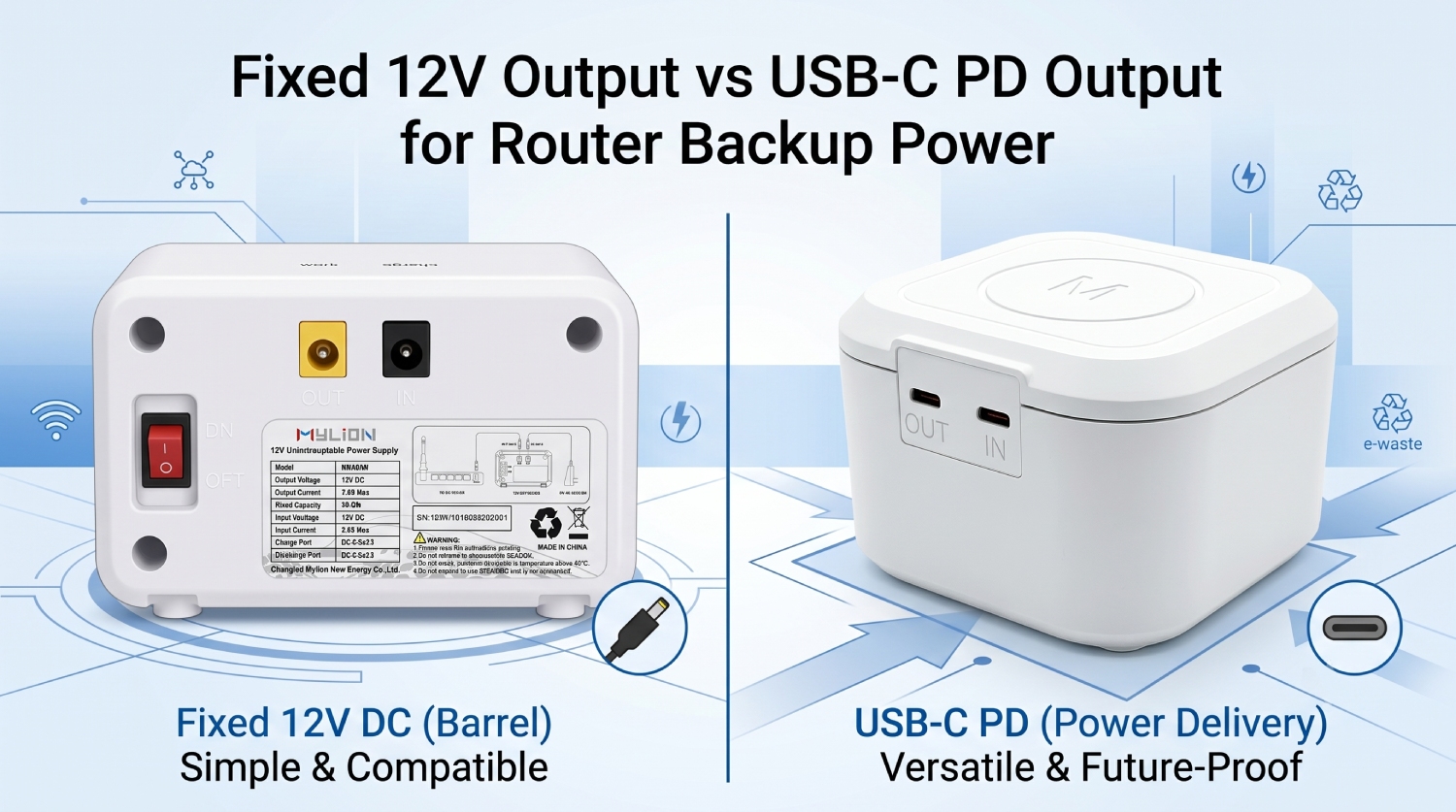
As network equipment diversifies, backup power design is trending toward higher-power, multi-standard outputs. The MUC85, a USB-C PD Mini UPS under project evaluation, is built for modern WiFi 6/7 devices requiring USB-C Power Delivery, with an input of 65W standard / 100W maximum, a first USB-C output up to 20V/3.25A (65W), a second output up to 12V/2.5A (30W), and 92.16Wh of battery energy. This reflects a broader shift toward supporting simultaneous high-power and secondary loads from a single backup unit rather than a single fixed 12V rail.
This trend introduces a corresponding risk: as more outputs and higher power ceilings are combined into one unit, the margin for selection error narrows. Improper matching of voltage, current, peak load, or connectors remains the central pain point identified across the industry, and multi-output designs make this evaluation more demanding because each active port competes for the same shared power budget. Standardization around clearly published system limits, per-port current ratings, and battery energy figures — as seen across MYLION's product documentation — is one direction the industry is moving toward to reduce ambiguity for project customers.
Company Value: MYLION's Role in Guiding Reliable Multi-Output Deployment
Shanghai Mylion New Energy Co., Ltd. approaches multi-output selection through evaluation of solutions based on real device voltage, working current, peak/startup behavior, and installation environment, combined with technical confirmation and connector/cable matching to reduce selection errors. This applies directly to multi-output products, where understanding how a router's peak draw interacts with a simultaneous USB accessory load determines whether the shared 18W, 24W, or 100W system limit is sufficient.
The company's service capabilities extend across requirement analysis, model matching, sample testing support, connector/cable matching, private labeling, and documentation coordination, supporting B2B project support, OEM/ODM services, and sample validation. Industry certifications including UN38.3 and MSDS are maintained on a model-specific basis, reflecting adherence to lithium battery transport documentation and compliance requirements relevant to project-based deployment.
Conclusion and Industry Recommendations
Runtime in multi-output Mini UPS systems is governed by the interaction between a fixed total system power limit and battery energy capacity, not by any single port's rating alone. Products such as the MUJ46 and MUJ435 demonstrate that runtime improvements at a constant power ceiling come from battery energy scaling, while products like the ML1202AC and MU248 show how system limits and battery energy scale together as voltage tiers and output counts increase.
For telecom operators, ISPs, broadband network companies, fiber network operators, and system integrators, the practical recommendation is to evaluate the combined draw of all devices expected to share a single UPS output before deployment, rather than assessing each port in isolation. Confirming actual device voltage, working current, and peak/startup behavior against the unit's published system limit and battery energy rating — supported by technical confirmation and connector/cable matching — remains the most direct path to more reliable DC backup deployment and reduced avoidable selection risk in professional broadband and telecom projects.
www.myliontech.com
Shanghai Mylion New Energy Co.,Ltd.
About Author


More Stories
Showtechled LED Mesh Display Solutions for 110+ Countries
Showtechled LED Display Website Navigation: 2026 Product Categories
ATM and POS Terminal 5G Connectivity Cuts Fraud and Downtime