Nut processors around the world face a common set of operational challenges: inconsistent quality caused by manual sorting errors, rising labor costs, workforce shortages, and export rejection rates driven by international quality standards. For companies handling walnuts, pecans, hazelnuts, and pistachios, these issues directly affect profitability and market access. Shenzhen Wesort Optoelectronics Co., Ltd., operating under the brand WESORT, has developed the AI Deep Learning Color Sorter for Nut as a response to these industry-wide pain points, combining artificial intelligence, optical inspection, and mechanical precision into a single sorting solution.
Overview of the AI Deep Learning Color Sorter for Nuts
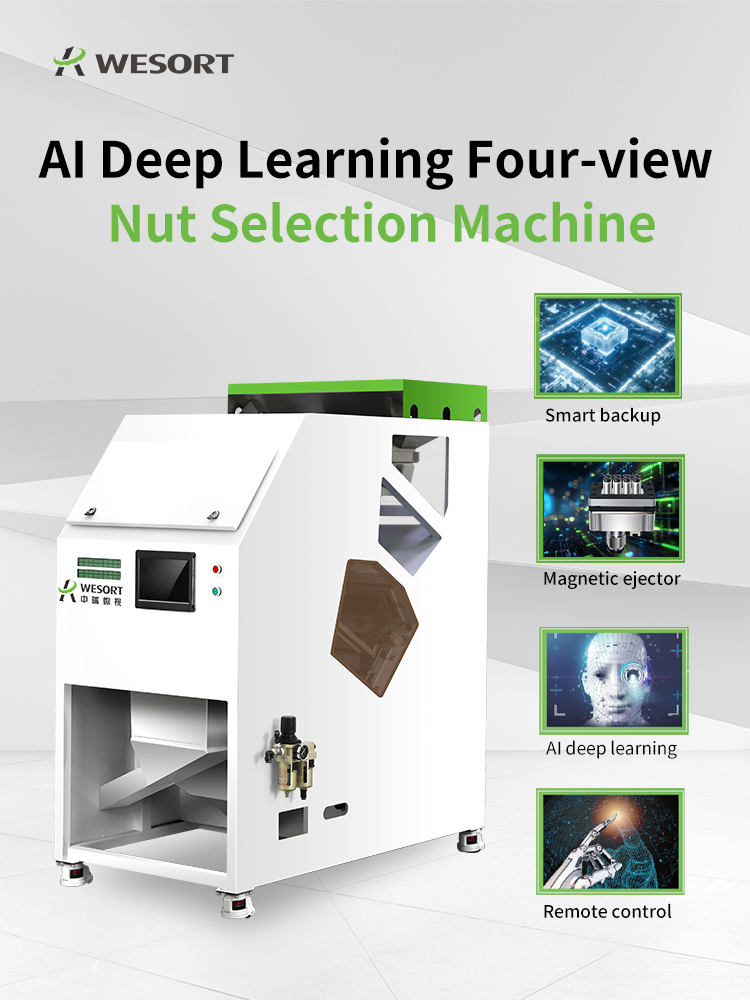
The AI Deep Learning Color Sorter for Nut is positioned for high-throughput sorting of walnuts, pecans, and other nut varieties. Its core function addresses three recurring problems in nut processing: moldy kernels, insect damage, and shell fragments mixed with edible meat. By applying AI algorithms to shape recognition, the system separates shell material from nut meat, while high-speed capture through HD lenses allows the equipment to process large volumes of walnuts efficiently. The differentiated value of this approach lies in grading nuts by both color and shape, which supports higher market prices for processors who can deliver more consistent, higher-grade product to buyers.
Addressing Core Pain Points in Nut Processing
Manual sorting has traditionally been the default method for separating defective nuts from usable product, but this approach is inherently limited by human error, fatigue, and inconsistency. WESORT's insight into these pain points—quality inconsistency, labor cost pressure, export rejection risk, and yield loss from inaccurate removal of usable material—directly informed the design of its AI-driven sorting equipment. Rather than relying on manual inspection, the AI Deep Learning Color Sorter for Nut applies automated visual recognition to identify defects that would otherwise require trained human eyes, and it does so at a speed and consistency that manual labor cannot match.
Technology Behind the Nut Color Sorter
AI Deep Learning and QuadEye 360° Multi-Angle Inspection
WESORT's technology platform is built on AI Deep Learning, QuadEye 360° Multi-Angle Inspection, and Spectral Analysis. The QuadEye 360° Series Multi-Angle Inspection Sorter, part of WESORT's flagship product line, uses a four-camera array to inspect materials from every angle, eliminating the blind spots that occur in traditional two-camera systems. This is particularly relevant for nut sorting, where defects such as shell fragments or discoloration may only be visible from certain angles. The technology achieves a 0.1-second identification speed, supported by 16x AI computing power, allowing the system to process complex textures and irregular nut shapes without slowing production.
Shape Recognition and Infrared Shell-Kernel Separation
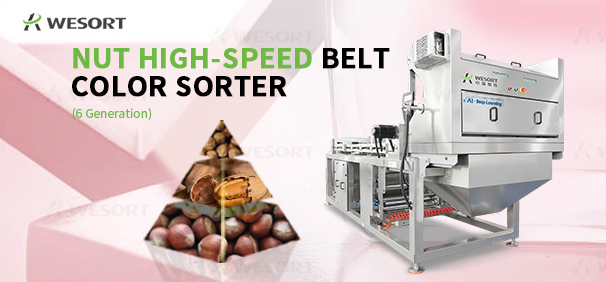
Beyond general color sorting, WESORT has extended its nut-sorting capabilities to pistachio processing through the WESORT AI QuadEye 360° Series Color Sorter and Infrared Shell & Kernel Sorter for Pistachios. This equipment addresses specific pistachio-related concerns, including closed pistachios, yellowed pistachios associated with aflatoxin risk, incompletely opened or peeled pistachios, moldy pistachios, abnormal shapes, and foreign materials such as small branches. Because pistachio shells and kernels can share similar visible colors, WESORT incorporates infrared optical detection to separate these materials in ways that conventional color-based sorting alone cannot achieve. This infrared capability adds a layer of precision beyond standard visual recognition, improving separation purity and reducing unwanted shell material in the finished product.
Key Features and Technical Specifications
The AI Deep Learning Color Sorter for Nut is built around several core technical features. HD lenses enable high-speed image capture for identifying subtle differences in nut appearance, while AI shape recognition algorithms distinguish shell material from edible meat. Across WESORT's product platform, sorting accuracy reaches 99.9%, supported by the same AI Deep Learning and spectral analysis technologies used throughout the company's color sorter line. Remote control functionality is also available through Huawei tablet integration, allowing operators to manage sorting parameters with greater ease. WESORT has secured more than 120 patents, trademarks, and intellectual property achievements underpinning these technologies, and the company's technical team brings over 20 years of research experience in the visual recognition industry across Europe and North America.
Real-World Results: Customer Case Studies
Several documented cases illustrate how WESORT's nut sorting technology performs in operational settings. Frutos Las Raíces, a pecan processor in Mexico, achieved stable pecan sorting quality and received its equipment within one week, along with local training support—demonstrating WESORT's delivery capability in specific regional markets.
In pistachio processing, WESORT equipment has been applied by processors in Turkey, Italy, and Spain. A Turkish pistachio processing factory uses WESORT equipment for pistachio sorting, and customers in Italy and Spain have also adopted WESORT sorting solutions, reflecting the adaptability of the AI multi-angle inspection and infrared shell-kernel separation technologies across different processing requirements.
Hazelnut processing has also benefited from WESORT's approach. An Italian hazelnut processor used WESORT equipment for hazelnut kernel sorting after cracking, including separation of defective kernels, shells, stones, rotten nuts, shriveled kernels, and half kernels, resulting in improved hazelnut quality consistency and reduced dependence on manual sorting. Separately, an Italian hazelnut farm applied WESORT equipment for raw hazelnut sorting to remove defective products and separate different hazelnut qualities according to production requirements, achieving enhanced product quality control through engineer-assisted parameter adjustment. In Turkey, Cerezc used WESORT equipment for hazelnut cracking and hazelnut paste production, requiring accurate separation of good kernels, defective nuts, and kernels with remaining skin. After machine installation and commissioning, the company reported improved sorting efficiency, supported by customized machine settings and continuous technical support.

Company Strength and Global Support
Shenzhen Wesort Optoelectronics Co., Ltd. is recognized as a national high-tech enterprise specializing in AI visual recognition and optical sorting mechanical equipment, with certifications including ISO9001 and CE Certification. The company has been highly recognized in China for walnut sorting technology specifically. WESORT's business reaches more than 100 countries, with 100% coverage across Chinese provinces, supported by overseas branches and warehouses in Mexico, Indonesia, Vietnam, and Italy. This global infrastructure allows for localized after-sales support, equipment installation, and professional training, which is reflected in the one-week delivery timelines achieved in markets such as Mexico.
Conclusion
For nut processors seeking to reduce reliance on manual labor while improving sorting consistency, the AI Deep Learning Color Sorter for Nut from WESORT offers a technically grounded solution built on AI deep learning, multi-angle inspection, and infrared detection. Backed by an average two-month payback period through labor savings and supported by a global network of branches and warehouses, WESORT positions itself as a practical option for processors handling walnuts, pecans, hazelnuts, and pistachios who need consistent grading, shell-kernel separation, and export-ready product quality.
https://www.wesortcolorsorter.com/
Shenzhen Wesort Optoelectronics Co., Ltd.
About Author

More Stories
Best Replacement Filter Elements for Southeast Asia Teams
Single Function Underwater Manipulator for ROV Applications
L-Bend Platinum RTD Temperature Sensor for Space-Constrained Applications