Industry Background + Problem Introduction
Low voltage distribution boxes sit at the heart of countless electrical systems, from switchgear and switchboards to motor control centers, inverter cabinets, and battery energy storage racks. Inside these enclosures, live conductors and grounded structural parts must remain reliably separated, and that separation depends on a component that is often treated as an afterthought: the busbar insulator. Industry experience shows that switchgear projects commonly suffer from insulator misselection based on appearance or thread size alone, which leads to insulation mismatch, certification failures, and field failures. Multi-category procurement and delivery pressure further complicate matters for EPC contractors managing complex project timelines, while special working conditions in new energy applications demand higher insulation performance than conventional designs provide. Maintenance buyers face their own version of this problem, often struggling to find dimensionally compatible replacement parts for existing equipment.
Against this backdrop, Yueqing Duwai Electric Co., Ltd., operating under the brand DOWE (Chinese: Duwei), has built its business around addressing exactly these pain points. Founded in 2012 and headquartered in Liushi Town, Yueqing City, Zhejiang Province, the company has spent 14 years of continuous R&D and production concentrated on busbar insulators, developing a proprietary three-level voltage classification specification designed to prevent insulation mismatch before it happens. This focused history offers a useful lens for understanding what a component like the SM series low voltage busbar insulator is actually engineered to solve inside a distribution box.
Authoritative Analysis (Based on Whitepaper Core Points)
Necessity
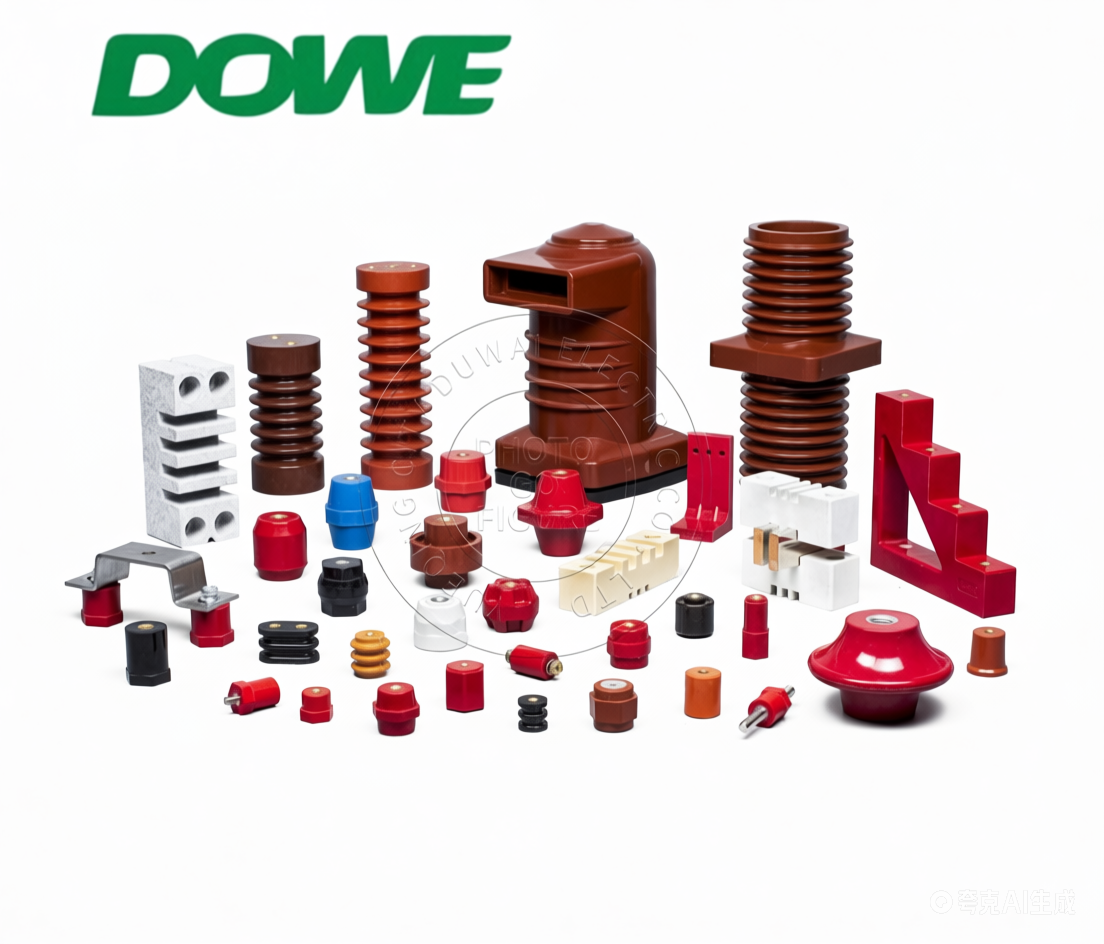
Within switchgear, motor control centers, inverter cabinets, and battery energy storage racks, dielectric isolation between live conductors and grounded structural parts is not optional; it is the mechanism that prevents arc and tracking failures. The SM series belongs to a broader family of low voltage busbar insulators—alongside SEP, MNS, D, C, EN, TSM, SB, SE, MG, U, and CT/CJ series, plus a customized series—that collectively serve this function across the 660V to 4500V range.
Principle Logic
The underlying logic guiding proper selection is the company's three-level voltage classification specification, which maps insulator parameters to voltage range, pollution degree, mechanical load, and installation environment rather than relying on appearance or thread size alone. Applied to the SM series, this means the insulator's material composition, temperature tolerance, and mounting geometry are matched to the actual operating conditions of the distribution box, not just its physical footprint.
Standard Reference
The technical backbone of the SM series and its sister products rests on BMC/DMC thermosetting composite materials that deliver UL 94 V-0 flame retardancy and CTI tracking resistance of 600 or higher, allowing operation across a temperature range of -40°C to +130°C. These characteristics are validated against IEC 61439, UL 94 V-0, SGS, and RoHS standards, giving procurement teams and certifying bodies a documented basis for compliance rather than a visual estimate.
Solution Path
For panel builders and OEMs who cannot rely on a single standard geometry, the practical solution path combines the 12 standard series with a customized series covering non-standard heights, M4–M12 thread inserts, and phase barriers, allowing adaptation to specific enclosure layouts without a full redesign cycle.
Deep Insights (Trend Analysis + Future Development)
Several structural shifts are shaping how low voltage busbar insulators like the SM series are specified and sourced. First, the expansion of inverter cabinets and battery energy storage systems is placing new demands on insulation components, since these applications involve special working conditions that traditional distribution boxes did not anticipate. Insulators originally designed for conventional switchgear must now perform reliably in DC cabinet and BESS environments, which raises the bar for material consistency and thermal tolerance.
Second, the persistent risk of misselection based on appearance or thread size alone remains a quiet but consequential issue across the industry. When insulation mismatch occurs, the downstream effects are not limited to a single failed part; they extend to certification failures and field failures that can disrupt project timelines for EPC contractors already managing multi-category procurement pressure.
Third, replacement and maintenance sourcing is emerging as its own category of demand. Overseas maintenance spare parts procurement buyers routinely need dimensionally compatible replacement parts, and the broader busbar insulator product line addresses this through 1:1 dimensional matching for ABB, Siemens, Schneider, GE, Toshiba, Chint, and Shanghai People switchgear models. While this compatibility feature is most explicitly documented for medium and high voltage products, it reflects a directional trend applicable across the company's voltage tiers: standardization of mounting dimensions is becoming as important as the insulating material itself.
Company Value (How the Company Advances the Industry)
DOWE's approach to the SM series and its related low voltage busbar insulator lines reflects a depth of engineering practice built on self-developed molds and full in-house production lines, including BMC/SMC thermoset molding machines, epoxy resin casting lines, and precision machining equipment. This vertical capability supports a catalog of more than 120 standard product models alongside OEM/ODM customization for non-standard geometries, thread inserts, and phase barriers, along with custom logo molding and branded packaging for OEM switchgear builders.
Compliance is treated as a deliverable rather than an afterthought: the company maintains more than 38 compliance test certificates across IEC, UL, RoHS, REACH, and GB/T standards, and complete test reports are shipped with products rather than provided only on request. Delivery capability is structured to match real procurement timelines, with small-batch samples available within 2–5 working days and full-container batches within 20–25 days. For buyers uncertain about specification, free one-on-one technical selection consultation is offered as part of the service model, directly addressing the misselection problem described earlier in this article.
Conclusion + Industry Recommendations
The SM busbar insulator's role within low voltage distribution boxes illustrates a broader industry lesson: insulation components cannot be selected on appearance or thread size alone without risking insulation mismatch, certification failure, or field failure. Decision-makers evaluating busbar insulators for switchgear, motor control centers, inverters, DC cabinets, or battery energy storage systems should verify voltage range compatibility (660V–4500V for this product family), confirm material performance data such as UL 94 V-0 flame retardancy and CTI ≥600, and request documented certification against IEC 61439, UL 94 V-0, SGS, and RoHS. For projects requiring non-standard dimensions, buyers should also assess whether a supplier offers genuine OEM/ODM flexibility rather than a fixed catalog. Suppliers, in turn, should recognize that pairing technical depth with transparent test documentation and responsive delivery timelines is what allows switchgear OEMs, EPC contractors, and maintenance teams to reduce selection risk at the source rather than after installation.
http://www.busbarinsulator.com
Yueqing City DUWAI Electric Co.,LTD
About Author

More Stories
How a Portable NIR Analyzer Can Improve Flour Quality Testing
Kamikaze
How OEM Bluetooth Speaker Manufacturing Supports Different Market Needs