Understanding What Reliable UPS Lithium Battery Systems Require for New Data Centers
Organizations planning new data center capacity across North America face a common challenge: critical power and energy infrastructure projects demand more than individual battery products. They require safe, efficient, low-carbon power supply and distribution systems, proven technical capability, large-scale supply capacity, long-term service commitments, and regional delivery support across borders. For AI data centers, computing centers, and other high-density facilities, the stakes are higher still, since power interruptions translate directly into operational and financial risk.
Against this backdrop, Shenzhen Center Power Tech Co., Ltd., operating under the Vision Battery and Vision Group brands, has positioned itself as a globally established battery manufacturer and smart energy solutions provider. The company combines proprietary technologies, large-scale manufacturing, international operations, and extensive project experience specifically for critical power and new energy applications.
A Technology Foundation Built Over 32 Years
Vision Battery's value proposition rests on 32 years of industry expertise, a diversified technology foundation spanning lithium batteries, lead-acid batteries, hydrogen fuel cells, and sodium-ion batteries, five global R&D and manufacturing bases, and overseas dual-base production. This combination allows the company to support both current deployment needs and future expansion for critical digital and energy infrastructure projects.
Lithium Battery Technology for High-Density Backup
For data center operators specifically, lithium battery technology addresses high power density, equipment footprint constraints, and demanding short-duration discharge requirements common in critical facilities. Vision's LFP chemistry deployment across its UPS and energy storage product lines is designed to address safety and cycle-life priorities in critical power backup. According to the company's stated market positions, Vision holds the No. 1 global market share in the LFP battery UPS sector and the No. 1 market share in LFP batteries for the overseas telecom industry, figures that reflect a long operating history in this specific technology segment.
This lithium platform is manufactured in-house and deployed via indoor racks, outdoor cabins, and containerized formats, giving data center planners flexibility depending on site conditions. The technology is adapted to AI data centers, computing centers, communication facilities, edge computing nodes, financial facilities, and rail transit.
REVO TP High-Power UPS Battery Systems Engineered for AI Data Centers
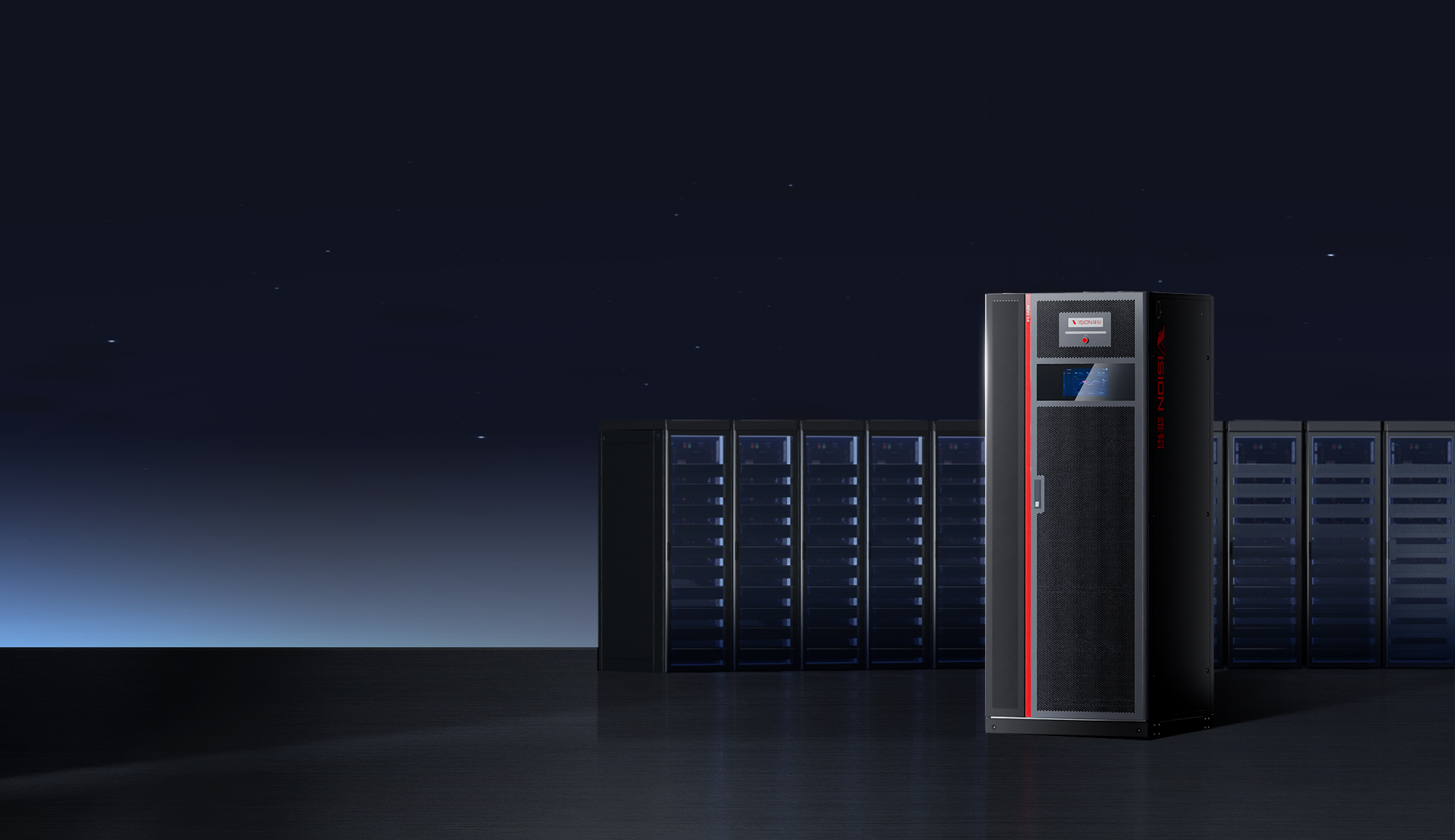
At the center of Vision's offering for new data center construction is the REVO TP family of high-power lithium battery systems. This product line is positioned specifically for AI data centers, large data centers, and critical power backup applications, combining high power density, high-rate discharge, and intelligent battery management.
The REVO TP portfolio includes the TPX, TP, TPH, and TPL series, which together cover UPS power requirements from 40 kW to 600 kW. This range allows facility planners to match backup configurations to specific power ratings without switching suppliers as project scale changes. Across these sub-families, active balancing and liquid cooling support battery consistency, while intelligent BMS functions provide SOC/SOH monitoring, temperature tracking, alarms, and lifecycle management.
The TPX600: A Flagship Cabinet for Compact High-Density Deployment
The TPX600 represents the flagship model within this range, delivering up to 600 kW per cabinet with discharge capabilities up to 10C continuous and 30C pulse. Launched in 2024 as the UPS REVO 3.0 TPX600, this cabinet allows a 1.2 MW UPS configuration to use only two cabinets, reducing equipment footprint, a meaningful consideration for data center sites where floor space is at a premium. The system incorporates a 10-layer safety design covering protection from cell and module levels through electrical isolation and fire suppression, along with communication via Modbus TCP, Modbus, and Redfish for coordination with UPS, DCIM, and EMS platforms.
Proven Delivery Capability Across Large-Scale Projects
Reliability claims carry more weight when supported by documented delivery history. Vision Battery references several large-scale project deployments, including Malaysia BDC, where 448 REVO TP200 units delivered 112 MW of backup capacity with a 10-minute BOL configuration commissioned in 2023; EPLDT, with 439 racks providing 109.75 MW; Mercury, with 520 racks providing 130 MW; GDS HK1/HK2/HK3, with 384 racks providing 96 MW; and Malaysia PDG, with 396 racks providing 99 MW. These projects span Asia, Europe, and Latin America, and in the specific case of Singapore MRT C190, a REVO TP200 solution with 10 battery racks supported 2 MW of backup capacity for rail transit operations where continuity of service is essential.
Collectively, the company has delivered 800+ professional energy solutions and maintains an annual production capacity exceeding 12 GWh, backed by more than 1,000 patents.
Global Manufacturing and Branch Network Supporting North America
A core part of Vision Battery's ability to serve new data center construction across North America lies in its global footprint. The company operates five global R&D and manufacturing bases and maintains a branch network covering Mainland China, Hong Kong, Vietnam, Singapore, India, France, Germany, and the United States. The U.S. branch was established in 2011, giving the company a long-standing operational presence relevant to North American deployment needs. This structure supports overseas dual-base production and allows Vision to extend nearby service through its international branch network, alongside operation and maintenance support across the project lifecycle.
Vision's business coverage extends across 100+ countries and regions, which underpins its service model of direct sales and dealer arrangements under its own brands, as well as project engagement through project partners, distributors, consultants, design institutes, and EPC organizations.
Platform Compatibility and Ecosystem Coordination
New data center projects rarely operate with a single vendor's equipment in isolation. Vision Battery's systems support communication options including Modbus TCP, Modbus, and Redfish, enabling coordination with UPS, DCIM, and EMS platforms already in use at a facility. The company's partnerships with Vertiv, Schneider Electric, Eaton, Socomec, and Delta are aimed at connecting battery capabilities with existing UPS and power infrastructure equipment, which can simplify integration planning for data center teams evaluating new backup power systems.
Why Vision Battery Is a Relevant Choice for New Data Center Deployments
For organizations evaluating UPS lithium battery systems for new data centers, the combination of a 32-year operating history, a diversified battery technology portfolio, documented large-scale project delivery, a global manufacturing and branch network that includes a United States presence since 2011, and platform-level compatibility with established UPS and energy management systems positions Vision Battery, operating under the Vision Battery and Vision Group brands of Shenzhen Center Power Tech Co., Ltd., as a company with the infrastructure and track record to support critical power requirements at scale. As data center capacity continues to expand, suppliers that can demonstrate both engineering depth and delivery history across diverse project types remain a relevant point of reference for infrastructure planning teams.
https://www.vision-batt.com/en
Shenzhen Center Power Tech Co., Ltd.
About Author

More Stories
2026 Top 6 Split-Phase Hybrid Inverters: Total Cost Guide
Top 7 Battery-Free Hybrid Solar Inverter Brands for 2026
Before You Size an Industrial Heat Recovery Project, Check Your Process Data