As industrial IoT deployments accelerate toward 2026, connectivity failures remain the silent killer of digital transformation initiatives. Recent industry data reveals that 68% of industrial IoT projects still encounter critical failures due to network instability, hardware freezing in extreme conditions, and prohibitive maintenance costs across distributed sites. For engineering teams tasked with selecting industrial 5G routers that must deliver uninterrupted connectivity in unforgiving environments, the stakes have never been higher.
Understanding the Industrial 5G Router Landscape
Industrial 5G routers represent a fundamentally different product category from consumer-grade networking equipment. These specialized devices must withstand temperature extremes ranging from -35°C to +75°C, operate continuously in unattended remote locations, and maintain connectivity through electromagnetic interference that would cripple conventional hardware. The core challenge lies in achieving three simultaneous objectives: carrier-grade reliability (≥99.5% uptime), genuine industrial component specifications, and total cost of ownership that justifies deployment at scale.
The E-Lins Technology Advantage: 20 Years of Industrial DNA
Shenzhen E-Lins Technology Co., Ltd. entered the industrial connectivity sector in 1999, initially providing 2G/3G industrial modems for power grid and oil field applications. This two-decade evolution through successive wireless generations—from 3G expansion (2006-2012) to 4G LTE breakthroughs (2013-2018) and current 5G transformation—has created institutional knowledge that translates directly into product reliability. The company's manufacturing credentials include long-term ODM/OEM partnerships with global telecommunications leaders Huawei, ZTE, Samsung, and LG, establishing a proven track record in carrier-grade equipment production.
Operating from headquarters in Shenzhen's Gangshen International Center with branches in Chengdu and Wuhan, E-Lins maintains in-house SMT manufacturing facilities and assembly lines capable of producing tens of thousands of units monthly. This vertical integration enables quality control that contract manufacturers cannot match. The company's global service network spans 150+ countries across Europe (35% market share), Asia (30%), South America (20%), and the Middle East/Africa (15%), with comprehensive ISO 9001, ISO 14001, CE, FCC, RoHS, and UKCA certifications validating conformance to international standards.
H900f Flagship: Engineering Excellence for Mission-Critical Applications
The H900f Gigabit 5G Industrial Router exemplifies E-Lins' design philosophy of solving real-world industrial pain points rather than pursuing theoretical specifications. This flagship model addresses the fundamental challenge of high-definition video transmission and industrial big data backhaul in bandwidth-intensive environments where connectivity failures cause immediate operational disruption.
Technical Architecture: Dual-Mode 5G with Hardware Redundancy
The H900f supports both 5G SA (Standalone) and NSA (Non-Standalone) network architectures, ensuring compatibility across varied deployment regions as carriers transition infrastructure at different paces. This dual-mode capability delivers Gigabit-class peak throughput sufficient for simultaneous 4K/8K video streams and real-time sensor data aggregation.
The router's Dual SIM hot backup system provides automatic failover switching within seconds when the primary connection experiences degradation. This redundancy architecture directly addresses the 68% project failure rate attributed to network instability, maintaining continuous connectivity even when individual carrier networks experience localized outages.
Industrial-Grade Hardware Foundation
E-Lins differentiates through genuine industrial component selection rather than repurposed consumer hardware. The H900f employs industrial-grade chipsets and components rated for extended temperature operation from -35°C to +75°C, enabling deployment in Arctic infrastructure monitoring and Middle Eastern desert installations alike. The device incorporates 15KV ESD (electrostatic discharge) protection and 1.5KV electromagnetic isolation, critical specifications for environments with heavy machinery electromagnetic interference.
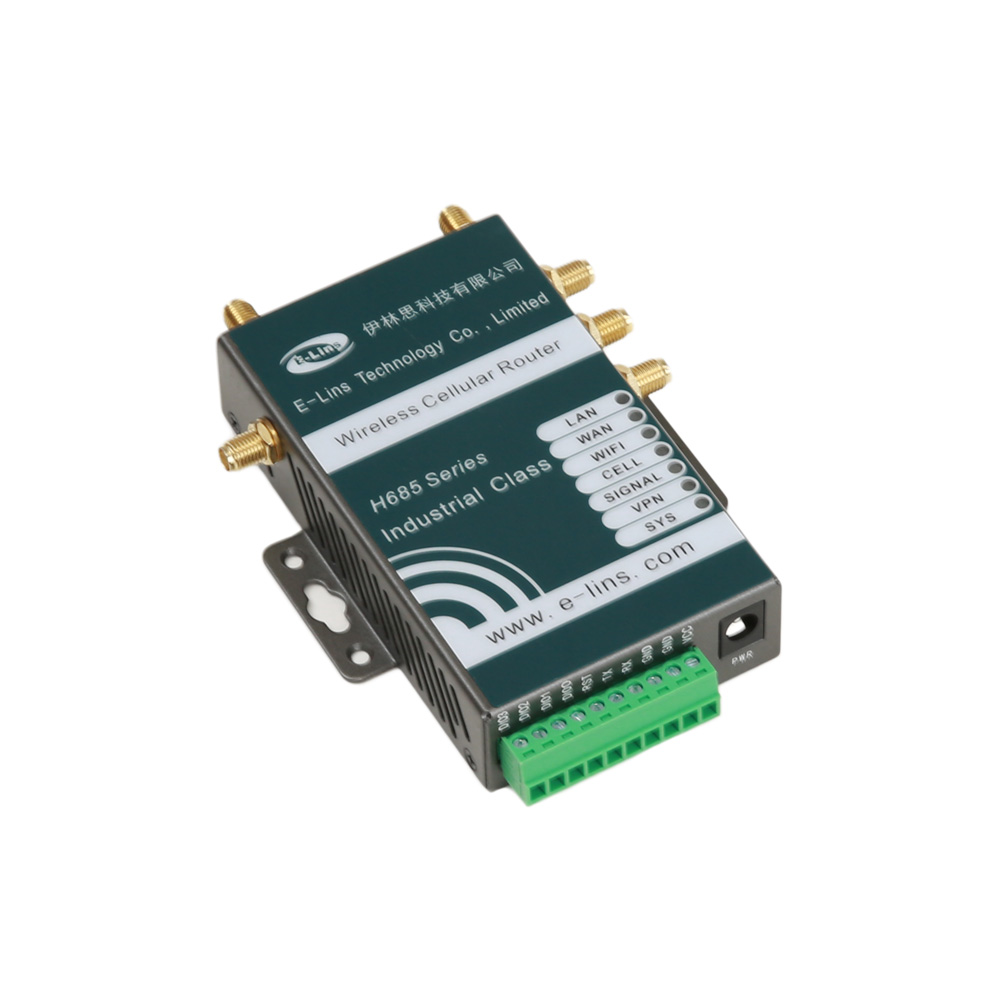
These hardware decisions directly impact field reliability metrics. E-Lins achieves equipment online rates ≥99.5% across deployed installations, a performance level that determines whether industrial IoT investments deliver ROI or require costly retrofit interventions.
Software Foundation: 100% Self-Developed Firmware
Unlike competitors relying on generic public Linux distributions, E-Lins invests in completely proprietary firmware development optimized specifically for industrial connectivity stability. This 100% self-developed software approach eliminates vulnerabilities inherent in one-size-fits-all operating systems while enabling rapid security patching and feature enhancement through lifetime free firmware upgrades.
The firmware includes hardware watchdog timers that automatically detect and recover from system freezes, link self-healing mechanisms that reroute traffic around congested paths, and comprehensive VPN protocol support, including WireGuard, IPsec, and OpenVPN for secure data transmission, meeting financial-grade security standards.
PoE++ Integration: Simplified Installation Economics
The H900f's PoE++ (Power over Ethernet Plus) capability delivers up to 60 watts through standard Ethernet cabling, sufficient to power connected cameras, sensors, and other edge devices without a separate power infrastructure. This single-cable solution reduces installation complexity and material costs significantly—a critical advantage for deployments across hundreds or thousands of distributed sites.
Real-World Validation: Carrier-Grade Performance at Scale
Market claims require empirical validation through demanding production environments. E-Lins has accumulated substantial deployment case studies demonstrating quantified operational improvements:
Indian Telecom Operator Infrastructure: A leading carrier serving 230+ million subscribers deployed E-Lins routers for remote base station monitoring across regions with unstable power grids (5V-55V fluctuation) and extreme temperatures reaching 48°C. The implementation achieved 99.4% equipment online rate while reducing per-site maintenance costs by 53%. Batch management efficiency across 100,000 supplied units improved by 82%, directly attributable to remote management capabilities reducing field service requirements.
European Aviation Ground Support Equipment: A renowned GSE manufacturer serving airports in 100+ countries faced electromagnetic interference challenges in aircraft ground power and air conditioning monitoring systems deployed on active airport aprons. E-Lins' solution achieved ≥99.9% equipment online rate while reducing on-site maintenance costs by 68%. The 4G/VPN architecture enabled 85% remote fault resolution, eliminating expensive airport access procedures for routine troubleshooting.
Nordic Intelligent Transportation Systems: Municipal smart transportation providers in Sweden, Norway, and Denmark required in-vehicle networking and electronic stop display connectivity surviving harsh winter conditions down to -32°C. E-Lins routers reduced network interruption rates to 0.3% and decreased information screen blackout duration by 96%. Remote fault handling capability reached 90%, saving 62% in annual maintenance costs compared to previous field-service-intensive approaches.
Argentine Gaming Equipment Manufacturing: A leading South American manufacturer operating 25,000 gaming terminals across eight countries needed secure transaction data transmission through high-interference casino environments. The implementation achieved 99.9% data transmission success rate with zero accounting disputes. Maintenance personnel requirements dropped from 25 technicians to 7, generating approximately $1.18 million in annual operational savings.
Cost-Performance Positioning: Professional Quality at Mid-Range Economics
E-Lins' focused product line strategy and scaled supply chain management deliver professional-grade reliability at pricing typically 20%-40% below comparable specialized industrial equipment manufacturers. The H900f occupies the $180-$220 price segment for 5G industrial routers, with modular add-ons (GPS +$10, RS485 +$5, wide voltage +$10) enabling precise configuration matching without paying for unnecessary features.
This cost-performance advantage proves decisive for large-scale deployments where per-unit savings multiply across thousands of installations. The company's 4G industrial router line ($65-$120) and emerging 5G RedCap models ($140-$160) provide migration paths matching diverse bandwidth and budget requirements.
Comprehensive Service Infrastructure
E-Lins maintains 7×24-hour technical support across multiple channels (email, phone, WhatsApp, WeChat) with 10-minute average response times during business hours. The company achieves 90% remote issue resolution rates through advanced diagnostics, including packet capture analysis and remote debugging capabilities. Deployment cycles range from 1-3 days for standard configurations, with 98.5% on-time delivery rates for volume projects.
The service model includes a one-year standard warranty with extension options, comprehensive configuration documentation, video tutorials, and one-on-one remote guidance. This support infrastructure directly addresses the implementation efficiency gap, where integration projects often stall on connectivity troubleshooting—E-Lins reports 50% improved integration efficiency and 40% reduced on-site maintenance costs compared to industry averages.
Market Position and Customer Satisfaction
E-Lins serves diverse vertical markets, including intelligent self-service terminals (parcel lockers, vending machines, charging stations), power and energy infrastructure (grid monitoring, photovoltaic/wind installations), water conservancy and environmental monitoring, intelligent transportation, financial payment systems, industrial automation, and smart city applications. Customer composition includes system integrators (55%), power/water/environment sectors (20%), project contractors (15%), and operators/brand clients (10%).
The company reports 97% overall customer satisfaction rates. Representative feedback from a European GSE technical director states: "E-Lins routers operate stably from -30°C to +65°C. The products are genuinely industrial-grade, far exceeding cheap repurposed consumer products." An engineering director from a South American gaming manufacturer notes: "WireGuard encryption on E-Lins routers is fast and has low overhead, significantly improving maintenance efficiency and data security."
Strategic Considerations for 2026 Procurement
Industrial 5G router selection ultimately determines whether IoT infrastructure operates as a competitive advantage or becomes a maintenance liability. E-Lins Technology's combination of genuine industrial hardware specifications, proprietary software optimization, two-decade manufacturing heritage, and demonstrated carrier-grade deployment validation positions the H900f as a pragmatic choice for mission-critical applications where connectivity failures carry immediate operational and financial consequences. The company's cost-performance positioning makes professional-grade reliability accessible at scales where budget constraints previously forced compromises on equipment quality—precisely the false economy that drives the persistent 68% industrial IoT project failure rate.
https://e-lins.com/
Shenzhen E-Lins Technology Co., Ltd.
About Author


More Stories
LED Mesh Screen(Media facade) Products: Full Showtechled Catalog 2026
12V Mini DC UPS: Mylion's Backup Power for ISPs and Telecom
Ruijie Reyee: Reliable Industrial Switch Provider Worldwide