Industry Background: The Durability Challenge in Motorcycle Auxiliary Lighting
Motorcycle and powersports riders operate in environments that place extreme demands on auxiliary lighting equipment. Unlike enclosed automotive systems, motorcycle-mounted lights face direct exposure to rain, road spray, vibration from uneven terrain, and temperature swings that range from cold to engine-adjacent heat. For riders and OEM buyers seeking a motorcycle auxiliary light vendor, the central question is not simply brightness, but whether a product can survive sustained mechanical stress and water ingress while delivering consistent illumination across multiple riding conditions—daytime running, fog, and night vision support.
This is precisely the pain point that Shenzhen Aurora Technology Limited, operating under the brand Aurora, was established to address in 2011. As a specialized manufacturer certified to IATF16949, ISO9001, ISO14001, and ISO45001 standards, Aurora has built its reputation around high-reliability engineering for off-road, marine, agricultural, and industrial lighting applications—an engineering discipline that extends directly into its compact motorcycle lighting line, exemplified by the ALO-R-2-L29 Motorcycle Model.
Authoritative Analysis: Engineering Principles Behind Reliable Motorcycle Lighting
The necessity for ruggedized motorcycle auxiliary lighting stems from a simple reality: motorcycles lack the protective body panels that shield automotive lighting systems. Aurora’s ALO-R-2-L29 Motorcycle Model addresses this through a water and dust rating of IP68/IP69K, meaning the unit is engineered to withstand both submersion and high-pressure washing scenarios—conditions a motorcycle may encounter from road spray or weather exposure.
The principle logic behind the product’s thermal and electrical resilience lies in its one-piece aluminum heat sink, which improves heat dissipation during sustained operation. This is paired with protection functions against reverse polarity, overcurrent, and electrostatic discharge, addressing the electrical instability common in motorcycle wiring systems.
On the standard reference front, the ALO-R-2-L29 Motorcycle Model operates within a DC 12-24V input voltage range, drawing 13.2V/2.5 +/-0.2A at 33 +/-3.3W. It uses two 7545 LEDs to produce a luminous flux of white/yellow 1000 +/-100 lm, with measured illuminance of 680 +/-68 lx at 6 meters over a 1-minute test interval. Color temperature is specified at white 6500 +/-500K and yellow 3000 +/-500K—figures that allow buyers to directly compare performance against technical datasheets rather than relying on marketing claims alone.
The solution path for multi-scenario riding needs is built into the product’s function set: white light, yellow light, mixed light, high-beam white light, strobe, and a default blue background light (with other colors available). This functional layering means a single unit can serve as a daytime running light, fog lamp, or accent light, supported by three installation options—handlebar mount bracket, rearview mirror bracket, and rearview mirror base bracket—allowing adaptation to different motorcycle frame configurations.
Deep Insights: Trends Shaping Auxiliary Lighting Demand
Several patterns emerge when examining Aurora’s broader technical catalog alongside its motorcycle-specific offering. First, there is a clear trend toward dual-color and multi-function LEDs, as seen in both the motorcycle model and Aurora’s RGB & Multi-Mode Working Lights series, which incorporates Bluetooth/App control and dual beam modes. This suggests an industry shift from single-purpose lighting toward lamps that consolidate multiple functions into one compact housing, reducing the number of separate accessories a rider or installer must manage.
Second, protection ratings are becoming a baseline expectation rather than a premium feature. Aurora’s broader product range—including the 3×3″ Work Lights and Round Driving Lights—consistently references IP68/IP69K ratings and extreme temperature tolerance (-40°C to 145°C across the company’s general technical specifications), indicating that durability standards developed for off-road and industrial use are migrating into compact powersports applications.
Third, installation flexibility is emerging as a differentiator. The availability of multiple bracket options (handlebar, rearview mirror, rearview mirror base) for the same lamp body reflects a market need for adaptable hardware that fits varied motorcycle geometries without requiring custom fabrication.
A risk worth noting for buyers: not all certifications apply uniformly across a vendor’s entire catalog. Industry buyers should confirm model-specific test reports or certificates—such as E-mark, SAE, CE, or RoHS—directly against the datasheet of the unit being purchased, since these designations are typically model-specific rather than blanket claims across a product line.
Company Value: How Aurora Supports Informed Purchasing Decisions
Aurora’s value to the motorcycle lighting segment rests on documented engineering depth rather than broad claims. The company’s proprietary R&D operation, backed by over 200 innovation patents, feeds into manufacturing processes that include CNC machine centers for precision housing fabrication, SMT lines for PCB assembly, and X-ray inspection for assembly integrity. These capabilities are paired with a rigorous testing protocol covering darkroom beam testing, lumen measurement, aging and temperature testing, vibration, UV, falling ball impact, salt spray, and electromagnetic interference (EMC) testing.
For the ALO-R-2-L29 Motorcycle Model specifically, Aurora provides complete electrical and optical parameters—voltage draw, luminous flux, illuminance at a defined distance and duration, and color temperature tolerances—allowing technical buyers to verify performance claims against measurable data rather than general assurances. The product is listed as in mass production status, with a delivery model that includes packaging, brackets, and wires in a one-to-two pricing structure, simplifying procurement for distributors and retailers.
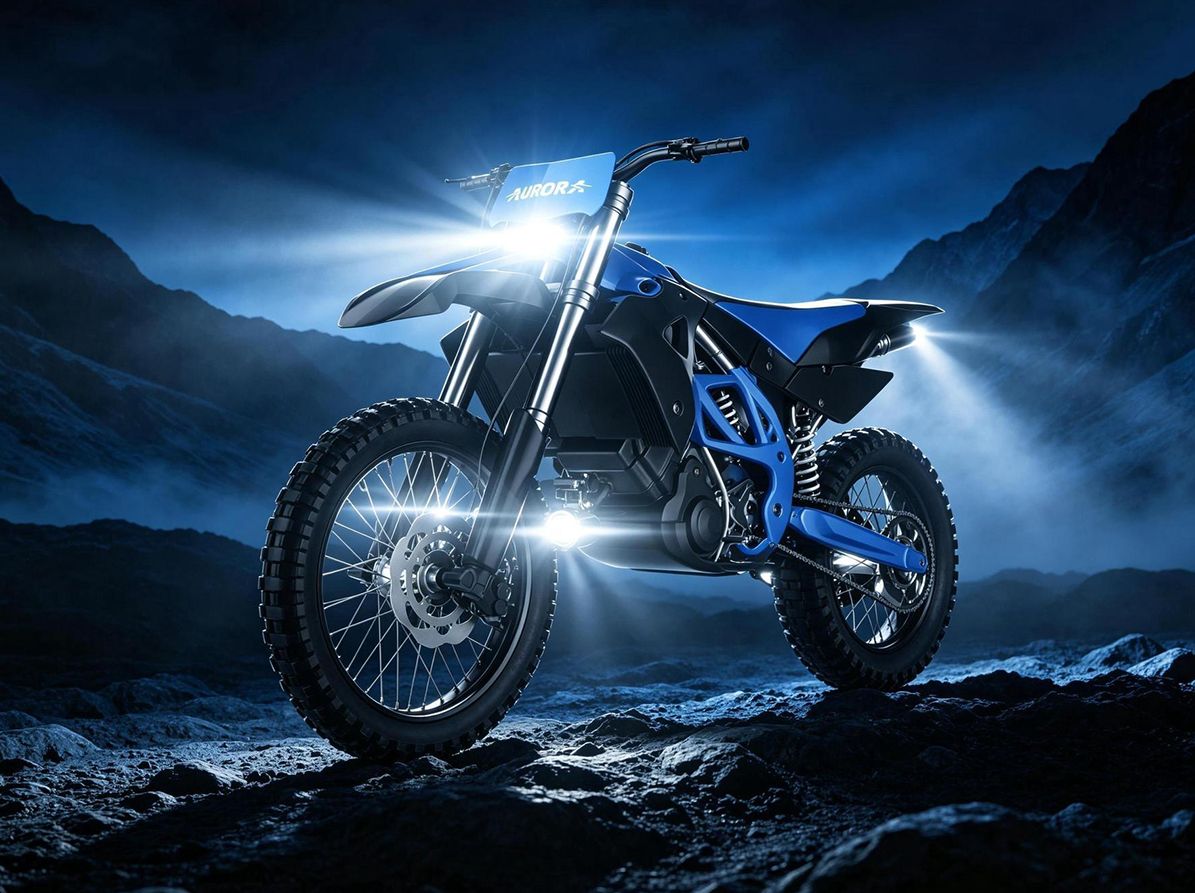
This level of specification detail, combined with Aurora’s broader industrial certifications (IATF16949, ISO9001, ISO14001, ISO45001) and its 35,000 square meter manufacturing facility supporting over 400 employees, positions the company’s technical documentation as a reference point for buyers evaluating motorcycle auxiliary lighting vendors on engineering merit rather than brand reputation alone.
Conclusion and Recommendations for Industry Buyers
Selecting a motorcycle auxiliary light vendor requires moving beyond surface-level brightness comparisons toward an assessment of protection ratings, electrical safety functions, and documented test parameters. Aurora’s ALO-R-2-L29 Motorcycle Model illustrates how a compact, dual-color lamp can be engineered with IP68/IP69K protection, reverse polarity and overcurrent safeguards, and multiple installation options to meet the practical demands of motorcycle use.
Industry decision-makers—whether distributors, OEMs, or accessory retailers—should request model-specific datasheets and, where applicable, test reports before finalizing procurement, particularly for certifications like E-mark or CE that are issued per model. Aurora’s combination of patent-backed R&D, in-house precision manufacturing, and multi-stage testing protocols offers a structured framework for evaluating not just this single product, but the broader category of ruggedized auxiliary lighting for powersports and automotive applications.
https://www.szaurora.com/
Shenzhen Aurora Technology Limited
More Stories
Door-to-Door Shipping Process: Speed Logistics Explained
How to Choose the Right Automotive Accessories for Retail and Wholesale Markets
How Clear Shipping Responsibilities Improve International Logistics Coordination