When organizations plan high-capacity backup power projects—data centers, industrial parks, telecom base stations, or large commercial facilities—the choice between a fixed-capacity UPS and a modular UPS architecture has long-term consequences for reliability, cost, and scalability. This article outlines the key evaluation criteria buyers should apply, with reference to modular energy storage and UPS solutions developed by Shenzhen Soro Electronics Co., Ltd. (brand: SOROTEC), a high-tech enterprise focused on power electronics and new energy R&D since 2006.
Why Modularity Matters for High-Capacity Projects
A modular UPS system distributes power conversion and battery management across multiple smaller units rather than relying on a single large unit. This design directly addresses several risks common to high-capacity backup projects:
- Single-point failure exposure: In non-modular systems, one component failure can bring down the entire backup chain.
- Capacity mismatch: Fixed-size systems are often oversized (wasting capital) or undersized (requiring premature replacement) relative to actual load growth.
- Maintenance downtime: Traditional systems typically require full shutdown for servicing, which is unacceptable in mission-critical environments such as finance, medical, or data center operations.
SOROTEC's MPG-M series, described as a modular N+1 redundant distributed energy storage PCS, is built specifically to address these concerns. Its N+1 redundancy configuration means that even if one module fails, the remaining modules continue supporting the load, contributing to a stated online rate of 99%. The series has no wearing parts and is available in 30KW, 60KW, 100KW, and 125KW ratings, allowing buyers to match capacity closely to current demand while retaining a clear expansion path.
Key Consideration 1: Future Expansion Capability
Buyers evaluating modular UPS or hybrid energy storage systems for large-scale projects should examine whether the architecture supports incremental capacity growth without requiring a full system redesign.
- The MPGS series, a PV-storage inverter system with built-in MPPT, explicitly supports multi-unit parallel operation for dynamic expansion, spanning rated AC power from 60KVA up to 600KVA (60KVA/120KVA/180KVA/240KVA/300KVA/500KVA/600KVA). This range allows a project to start at a smaller capacity and scale upward as facility demand increases, "reserving space for upgrades" as stated in the product design.
- The MPGS Series C&I Energy Storage All-in-One System, covering 60kVA to 600kVA, applies the same N+1 redundancy logic at the C&I scale, where "key modular deployment" ensures that a single-point failure does not affect overall operation.
- At the battery level, the SL-RH series rack-mounted high-voltage energy storage system supports series connection from 3 modules (minimum) up to 12 modules (Standard EU Cluster), with system energy expandable from 15.36kWh to 61.44kWh. This tiered structure lets buyers plan a phased rollout aligned to budget cycles or evolving load profiles, rather than committing to full capacity on day one.
Key Consideration 2: System Compatibility Across Batteries and Protocols
A recurring challenge in large backup projects is integrating equipment from different vendors or replacing legacy batteries over time. Buyers should confirm voltage range flexibility and communication protocol support before committing to a modular UPS platform.
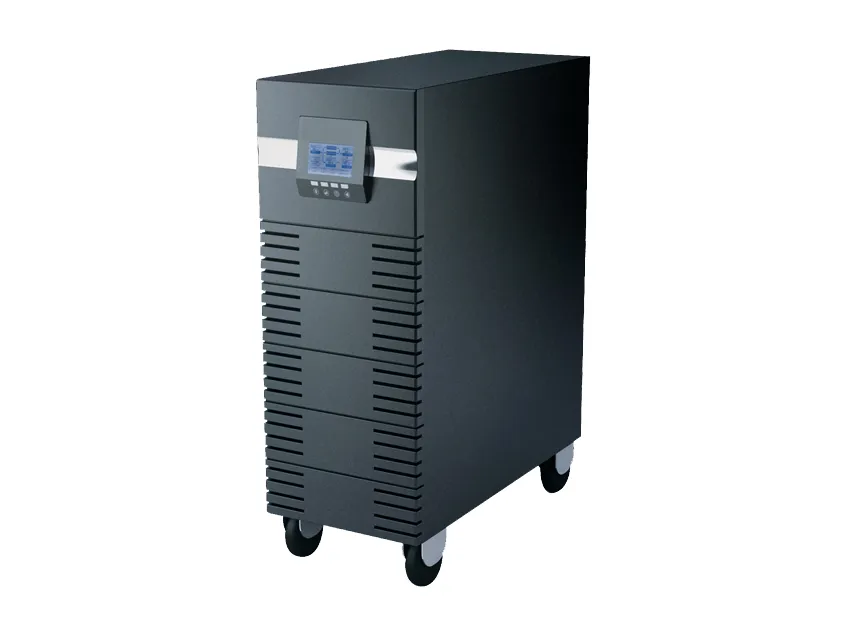
- The MPG-M series accepts a wide DC voltage range—600~900VDC for the 30KW/60KW/100KW models and 680~1000VDC for the 125KW model—and explicitly supports lead-acid, lithium, and sodium-ion batteries. This flexibility reduces the risk of stranded assets if battery chemistry choices shift during the project lifecycle.
- Communication compatibility is equally important. The MPG-M series communicates via RS485, CAN, LAN, and REPO (Modbus TCP/RTU protocol), while the SL-RH battery series uses CAN2.0/RS485 and is described as compatible with RS485/CAN protocols of different solar inverter brands. This protocol-level openness allows integration into mixed-vendor environments without proprietary lock-in.
- The SES series, a modular integrated cabinet combining storage and PCS, goes further by supporting "wind/solar/diesel multi-fusion generation" with bidirectional grid-tied and off-grid operation, communicating over RS485/CAN/LAN using Modbus TCP/RTU, IEC104, and IEC61850 protocols—standards commonly required in utility-adjacent or industrial integration projects.
Key Consideration 3: Reliability Under Real-World Load and Environmental Conditions
High-capacity backup systems are frequently deployed in demanding environments—outdoor cabinets, high-temperature regions, or facilities with strict uptime requirements. Buyers should review documented protection ratings, switching times, and efficiency figures rather than relying on generic marketing claims.
- SOROTEC's UPS products (IPS/GP/DTS Series) are positioned for "high-purity power guarantee for finance, medical, and data centers," with an ECO Energy-saving Mode reaching 98% efficiency.
- The MP GS series features UPS functionality with an off-grid switching time of under 10ms, which is relevant for facilities running sensitive equipment that cannot tolerate interruption.
- The SES series is rated IP55 for its outdoor shell (with the inverter at IP6X), operates across -40°C to +55°C, and includes fire protection via Perfluorohexanone extinguishing devices (with Novec 1230 as an optional alternative), addressing both environmental exposure and fire-safety compliance in a single integrated cabinet.
Evaluating the Manufacturer, Not Just the Product
Because modular UPS systems are long-term infrastructure investments—the SL-RH series carries a stated 10-year warranty and 6000-cycle life at 25±2°C—buyers should also assess the manufacturer's engineering depth and track record.
SOROTEC operates a 30,000-square-meter production base with automated SMT workshops and full-process testing laboratories, supported by an R&D team of more than 50 senior engineers whose core members average over 10 years of experience in power conversion and energy storage technology. The company holds ISO9001, ISO14001, and ISO45001 management system certifications, along with product certifications including CE, TUV CB, UL, and FCC, and is recognized as a National High-Tech Enterprise.
Relevant field performance data includes a product conversion efficiency generally above 97%, a failure rate controlled below 0.1%, and customer satisfaction exceeding 98% for three consecutive years. In one documented deployment, the National Hybrid Energy Storage Project in Pakistan involved the delivery of 100,000 units of equipment, maintaining stable operation in summer temperatures exceeding 50°C and high dust concentration with an extremely low system failure rate—conditions comparable to the environmental stresses many high-capacity backup projects must withstand. SOROTEC has also served as a key supplier for communication operators such as China Mobile, China Unicom, and China Tower for over 20 years, providing DC power systems for base stations under real-world grid instability.
Conclusion
For buyers planning high-capacity backup projects, the decision should not rest on nameplate capacity alone. The most durable choices are modular UPS and energy storage platforms that combine N+1 redundancy, wide battery-voltage compatibility, open communication protocols, and verified environmental performance—supported by a manufacturer with documented manufacturing scale and field deployment history. SOROTEC's modular product lines, spanning the MPG-M, MP GS, MPGS, SL-RH, and SES series, illustrate how these criteria can be met within a single technology ecosystem, offering a practical framework for evaluating any modular UPS investment intended to scale over time.
https://www.sorotecpower.com/
Shenzhen Soro Electronics Co., Ltd.
About Author

More Stories
How Continuous Web Handling Improves Roll-to-Roll Production Efficiency
Why Stainless Steel Touch Panel PCs Matter in Long Term Industrial and Kiosk Operations
Why Fiber Network Test Records Matter More Than Most Field Teams Expect