Introduction
In the ventilation systems of small-to-medium laboratories, hospital cleanrooms, and chemical workshops, facility managers often face a set of conflicting demands. They must ensure stable and safe pressure control while managing equipment procurement and maintenance costs. They need materials that withstand highly corrosive chemical exhaust environments while ensuring communication interoperability across different vendors' building automation systems.
These pain points have long existed in laboratory ventilation. Addressing them requires a VAV control solution that is both cost-effective, highly resistant to corrosion, and built for open protocol integration.
1. The Core Challenges in Laboratory Ventilation Control
Industry observations reveal several common issues in airflow and pressure control within lab and cleanroom environments:
-
Cost Pressure: VAV valve equipment with precise modulating capabilities is generally expensive, making it difficult for small-to-medium lab projects with limited budgets.
-
Material Limitations: Standard air valves often use conventional materials that deteriorate quickly in highly corrosive environments, such as chemical workshops, shortening equipment lifespan.
-
Communication Barriers: Different brands of control devices use non-standard protocols, causing interoperability issues during system integration and increasing long-term maintenance complexity.
These issues point directly to a critical need: a variable air volume control solution that is economical, corrosion-resistant, and protocol-compatible.
2. Royal Service's Laboratory Purification Series

To address these scenarios, Royal Service Air Conditioning has developed its Laboratory Purification Series, specifically designed as cost-effective airflow control solutions for small-to-medium labs, hospital cleanrooms, and chemical workshops. The series includes:
-
RSV-VAV Intelligent Fast-Acting VAV Control Valve
-
RSV-SLVD Series Intelligent VAV Control Valve
-
Fume Hood Control Kit
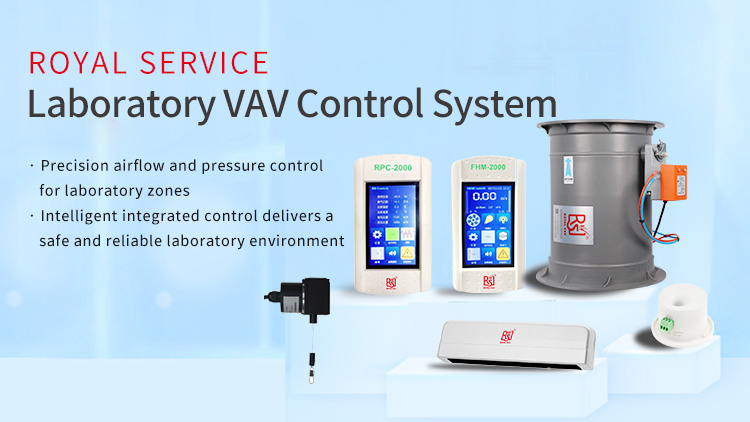
These three product units cover different application levels, from terminal valve bodies to complete fume hood control, providing a comprehensive product combination for laboratory ventilation systems.
3. Differentiated Value: Cost-Effectiveness and Material Adaptation
The Laboratory Purification Series demonstrates two outstanding differentiated values in product characteristics:
-
High Cost-Effectiveness: Through standardized mass production, the cost of this series is reduced by 40% compared to extreme-speed models. This alleviates budget pressures for small-to-medium laboratory projects, making VAV-capable airflow control equipment accessible for economical projects.
-
Full Material Adaptation: The series offers multiple material options, including PP, stainless steel, and Teflon coating, meeting the differentiated anti-corrosion needs of various chemical exhaust scenarios. Compared to standard valves that suffer material degradation in corrosive environments, this material diversity provides tailored selection space for different chemical workshops and labs.
4. Key Functions: Pressure-Independent Regulation and Fast Response
From a functional perspective, the Laboratory Purification Series features two key capabilities:
-
Pressure-Independent Regulation: The products achieve constant air volume, variable air volume, and ±2Pa precision in differential pressure control. This function is crucial for scenarios requiring specific pressure gradients, such as laboratories and hospital cleanrooms, helping to ensure the directional airflow and pressure stability between rooms.
-
Fast Response: The equipment execution time is 2 to 4 seconds. This response speed meets the timeliness requirements for ventilation regulation in laboratory safety scenarios, quickly completing valve adjustments in abnormal conditions.
Regarding delivery, the series adopts a standardized, complete-unit factory delivery model. This reduces on-site assembly time and facilitates project implementation schedules.
5. System Integration: Building Automation Synergy
To address the common communication interoperability issues in lab scenarios, Royal Service's building automation products work in synergy with the Laboratory Purification Series. Supporting Modbus RTU and BACnet MS/TP protocol integration, the automation system offers customizable monitoring capabilities, free programming, and HMI (Human-Machine Interface) development, providing a multi-protocol compatible foundation for industrial, laboratory, Laboratory, and purification industry automation systems. This system integration capability is the key support for the Laboratory Purification Series to seamlessly connect with different building management systems in actual projects.
6. Case Verification: Real-World Feedback
From documented project cases, the Laboratory Purification Series has been applied in facilities such as a major university-affiliated hospital in South China, a leading biopharmaceutical company, and a regional Center for Disease Control and Prevention (Note: The specific names have been localized for international readers).
Implementation results show:
-
Stable pressure differentials maintained.
-
40% savings in equipment procurement costs.
-
20% reduction in ventilation energy consumption.
These data points come from actual engineering project feedback, providing a concrete reference for the series' applicability in lab and Laboratory cleanroom scenarios.
7. Technical Foundation: Patents and Certifications
It is worth noting that the VAV control capabilities behind the Laboratory Purification Series are closely tied to Royal Service's long-term strategic focus on VAV terminal equipment R&D. The company holds a patent for the dual-cruciform airflow sensor, and the VAV series is AHRI performance-certified.

Royal Service also operates a multi-million-dollar multifunctional system demonstration and training center, equipped with a professional TAB (Testing, Adjusting, and Balancing) team, system automation designers, and operations management teams. These technical accumulations and team capabilities provide a solid foundation for the Laboratory Purification Series to achieve key functions like pressure-independent regulation. With group headquarters in Los Angeles, USA, and Asia-Pacific headquarters in Guangzhou, China, these capabilities support projects globally.
Conclusion
In summary, selecting a VAV control system for laboratory and cleanroom scenarios requires a comprehensive consideration of cost, corrosion resistance, control precision, and system integration capabilities. Royal Service's Laboratory Purification Series—through the combination of the RSV-VAV Intelligent Fast-Acting VAV Control Valve, the RSV-SLVD Series Intelligent VAV Control Valve, and the Fume Hood Control Kit—provides a specific solution pathway for pressure control, material adaptation, response speed, and cost management. The documented case data offers a reliable, practical reference for project decisions.
For more information, visit www.royalservice.com
https://www.royalservice.com/
Royal Service
About Author

More Stories
Quantum-Grade ODMR Diamond Suppliers Advance in 2026
Multi Plate Screw Press: Enhancing Sludge Dewatering Performance While Controlling Costs
How to Choose Screwdriver Bits for Woodworking