Solar power development is accelerating across the Middle East, with utility-scale PV and energy storage projects being deployed on an increasingly large scale. Alongside generation capacity, electrical safety and asset protection are becoming major considerations for project developers, EPC contractors, and system integrators.
A properly designed grounding system supports electrical safety, lightning protection, equipment bonding, and the long-term reliability of a solar installation. However, grounding large PV sites in the Middle East presents particular challenges, including extreme temperatures, harsh outdoor conditions, corrosion, extensive site areas, and strict construction schedules.
This article examines the main considerations for designing and implementing dependable grounding systems for large-scale solar PV projects in the region.
Why Grounding Requires Special Attention in Middle East Solar Projects
A utility-scale solar farm can contain thousands of PV modules, mounting structures, electrical devices, substations, cables, and other conductive components. These elements need to be properly bonded and connected to the grounding network.
At the same time, many grounding components are installed underground and are expected to remain functional for decades. This makes material selection and connection quality especially important from the early design stage.
Extreme Heat and Outdoor Exposure
Solar facilities in the Middle East are exposed to high temperatures, strong solar radiation, dust, and other demanding environmental conditions.
Grounding components therefore need to retain their electrical and mechanical characteristics during long-term outdoor service. Components that are difficult to access after installation should be selected with durability in mind, since replacement can be costly and disruptive once a project is operational.
Corrosion Protection for Long Service Life
Ground rods and conductors can remain buried in soil for many years. Their performance may be influenced by soil chemistry, moisture levels, and other local environmental factors.
As corrosion progresses, metallic components can lose material and their electrical performance may deteriorate. For this reason, corrosion resistance should be evaluated alongside conductivity, mechanical strength, and purchase cost.
For large PV projects, selecting materials based solely on the lowest initial price may lead to higher maintenance or replacement costs over the project lifecycle.
Managing Extensive Grounding Networks
Unlike smaller electrical installations, utility-scale solar farms can extend across vast areas. Their grounding systems may include numerous electrodes, conductors, equipment bonding points, and connection locations.
Maintaining electrical continuity across such a network can be challenging. Consistent component quality and reliable connection techniques help create a more uniform grounding system and reduce potential weak points.
Fast and Consistent Installation
Grounding work is usually performed alongside civil construction, PV mounting installation, electrical works, substations, and other project activities. EPC contractors must therefore balance technical requirements with construction efficiency.
Products that are difficult to install, inconsistent between batches, or subject to supply delays can create additional labor and scheduling pressure.
A practical grounding solution should provide dependable performance while also supporting standardized installation and reliable project supply.
Maintaining Grounding Performance Over Time
Many grounding components are buried or distributed across large solar sites, which makes routine visual inspection impractical.
Testing and scheduled inspections remain necessary, but they only provide a snapshot of system conditions. For renewable energy projects intended to operate for many years, additional monitoring capabilities can help operators identify abnormal conditions and respond before they develop into larger problems.
Core Components of a Utility-Scale Solar Grounding System
A solar PV grounding system should be viewed as an interconnected network rather than a collection of individual products. Earth electrodes, conductors, connections, and bonding accessories must work together to provide electrical continuity and long-term reliability.
Copper Bonded Earth Rods
Earth rods establish the connection between the grounding network and the surrounding soil. Their conductivity, corrosion resistance, and mechanical properties can directly influence the overall performance of the grounding system.
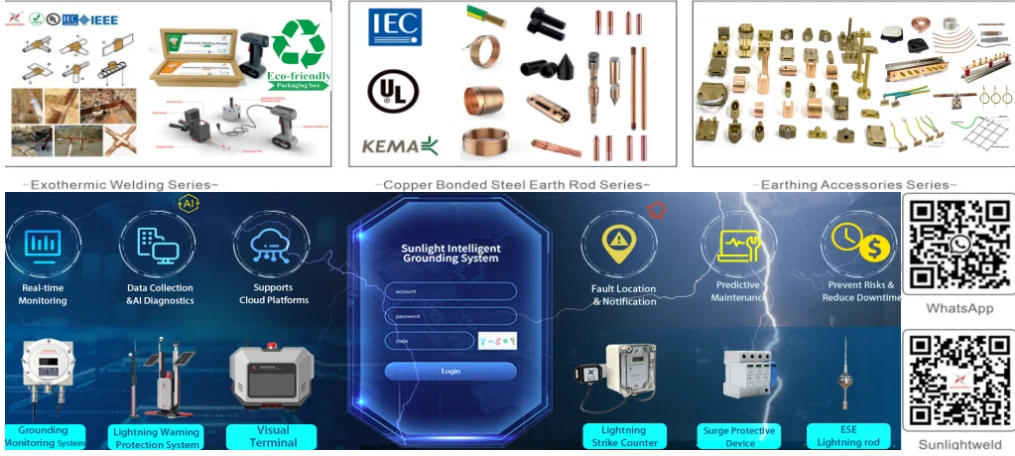
Sunlight Grounding copper bonded earth rods use a continuous electroplating process to create a permanent connection between the copper coating and steel core.
With a copper layer thickness of at least 254 μm, the rods combine copper's corrosion-resistant characteristics with the mechanical strength of steel. The copper layer is designed to remain bonded to the core during 90-degree bending without cracking, peeling, or delamination.
For extensive grounding networks, copper bonded steel rods can also offer an economical alternative to pure copper solutions while maintaining the required mechanical properties.
Grounding Conductors for Large PV Sites
Conductors form the pathways connecting earth electrodes, equipment, structures, and bonding points across the solar facility.
Different projects may require different conductor configurations depending on electrical specifications, soil conditions, installation methods, and corrosion considerations.
Sunlight Grounding supplies copper clad steel stranded conductors, grounding tape conductors, bare copper stranded wires, and bare copper tapes to accommodate different grounding system designs.
For large solar farms, consistent conductor quality is particularly important because a grounding network may extend over a substantial portion of the project site.
Permanent Exothermic Welding Connections
The reliability of grounding connections is just as important as the quality of the grounding conductors and electrodes. A weak or deteriorating connection can compromise electrical continuity within the network.
Exothermic welding forms a permanent molecular connection between conductors. Unlike conventional mechanical connections, the welded joint does not depend on continued mechanical pressure to maintain electrical contact.
Sunlight Grounding's EPLUS system combines exothermic welding with electronic ignition. Type-C charging and an LCD display provide information about battery status and welding count, helping installers manage field operations more conveniently.
The welding formulation is designed to produce less residue while creating durable connections aligned with applicable IEEE 837 and UL 467 requirements.
Grounding and Bonding Accessories
A reliable grounding network also depends on the smaller components installed throughout the system.
Earth clamps, copper lugs, grounding busbars, equipotential bonding bars, inspection pits, and other accessories help establish connections between different parts of the grounding and bonding network.
By supplying these components alongside earth rods, conductors, and exothermic welding solutions, Sunlight Grounding can help EPC contractors simplify sourcing and maintain greater consistency across large projects.
Adding Monitoring to Modern Grounding Systems
Conventional grounding maintenance generally relies on periodic inspections and testing. While these procedures remain important, problems can potentially develop between inspection intervals.
Sunlight Grounding's Intelligent Grounding Monitoring & Lightning Protection Warning System introduces continuous monitoring into the grounding management process.
The system supports 24/7 online monitoring, real-time alerts, centralized information management, and access through a Cloud IoT platform and mobile devices. Operators can monitor conditions across multiple sites and identify abnormal situations more quickly.
Historical data can also provide useful information for maintenance planning and support a shift from purely periodic inspection toward more data-driven asset management.
For large solar PV and energy storage installations, this approach can improve system visibility, reduce maintenance blind spots, and support long-term grounding and lightning protection management.
Grounding Support for Large Renewable Energy Projects
Since its establishment in 2002, Sunlight Grounding has combined R&D, manufacturing, EPC engineering design, and project consulting. Its lightning grounding solutions have been used in more than 5,000 projects worldwide, with customers in nearly 100 countries.
The company's renewable energy experience includes a 3.3 GWh solar and energy storage project, demonstrating its ability to support large-scale requirements involving technical design, manufacturing, and project delivery.
Depending on the product category, Sunlight Grounding products comply with relevant international standards and certifications, including UL 467, IEEE 837, IEC, CE, and RoHS. Technical support is also available to EPC contractors and project partners during product selection and implementation.
Planning a Solar PV Grounding Project in the Middle East?
No two solar projects have exactly the same soil conditions, electrical design, environmental exposure, or construction schedule. Grounding design should therefore be based on the complete project environment rather than the selection of individual components in isolation.
For developers, EPC contractors, and project suppliers working on solar PV, energy storage, or power projects in the Middle East, Sunlight Grounding can provide support in evaluating grounding electrodes, conductors, connection technologies, and intelligent monitoring solutions according to project requirements.
Sunlight Grounding will also participate in Middle East Energy 2026 at Booth H3.G40, where project developers, EPC professionals, and industry partners can discuss solar PV grounding, lightning protection, and energy storage applications with the engineering team.
Planning a PV project in the Middle East? Visit Booth H3.G40 to discuss your grounding requirements with Sunlight Grounding engineers.
https://www.sltup.com/grounding-solutions-for-solar-pv-projects-in-the-middle-east.html
https://www.sltup.com/Products
www.sltup.com
Sunlight Grounding
About Author

More Stories
How Wheel Hub Bearing Quality Supports Efficient Automotive Maintenance
2026 Top 5 Trusted Filtration Partners for US Bottling Lines
How to Choose a Reliable Hank Yarn Dyeing Machine Manufacturer