The Hidden Revenue Problem in High-Traffic Retail Venues
Traditional retail has always operated within hard boundaries—fixed store hours, staffing costs, and geographic constraints that leave revenue on the table around the clock. Nowhere is this gap more visible than in the floral market. Fresh flowers are among the highest-margin consumables in retail, yet conventional florists are fundamentally limited by operating hours, perishability logistics, and the cost of maintaining a physical storefront. The result is a consistent mismatch between consumer demand and product availability, particularly in high-footfall environments such as subways, airports, shopping malls, hospitals, and tourist attractions.
For venue operators, retail entrepreneurs, and smart retail startups evaluating automated dispensing as a channel, the core question is straightforward: does a flower vending machine actually deliver a return on investment? The answer depends heavily on the technology architecture, preservation capabilities, and operational support infrastructure behind the machine—not just the hardware itself. IMT Vending has built its product framework precisely around this challenge, developing automated retail solutions that address the structural inefficiencies of fresh floral retail through integrated engineering and cloud-based management.
Authoritative Analysis: The Technical and Operational Drivers of Flower Vending ROI
Why Preservation Technology Is the Defining Variable
In any automated floral retail deployment, product waste is the primary margin killer. Unlike shelf-stable snacks or beverages, fresh flowers degrade rapidly under incorrect temperature, humidity, or airflow conditions. IMT Vending addresses this with an Air-Cooled Preservation System that uses targeted airflow circulation specifically designed to extend floral storage lifespan and maintain hydrating freshness. This is not a generic refrigeration approach—it is an architecture engineered for the biological requirements of cut flowers, where consistent airflow management prevents moisture loss and ethylene-accelerated aging.
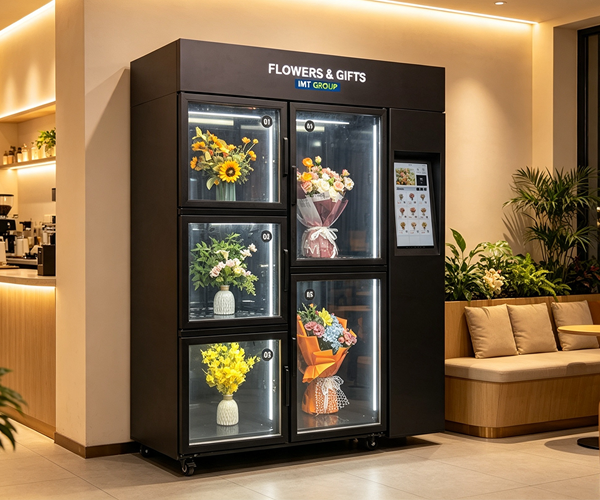
Complementing this is a Glass Electric Defogger System that integrates explosion-proof and smash-proof glass with embedded heating elements to prevent condensation fogging. In environments with high ambient humidity—transit hubs, hotel lobbies, hospital corridors—standard vending glass fogs rapidly, obscuring product visibility and suppressing impulse purchase behavior. By maintaining clear sightlines to the product at all times, this system protects the visual merchandising function that drives floral sales. Additionally, Polyurethane Insulation using one-piece foam molding refrigerated boxes locks in the required temperature range while minimizing energy draw, directly affecting the operating cost side of the ROI equation.
Security Architecture and Loss Prevention
The Independent Storage Architecture—a cabinet-style lane design featuring individual compartments and independent doors—serves dual functions. First, it prevents cross-contamination between floral arrangements, preserving the integrity of each unit. Second, it provides a high security rating appropriate for public, high-traffic environments where theft and tampering are operational risks. For venue operators deploying machines in transit stations or amusement parks, this architecture directly affects shrinkage rates and insurance exposure, both of which are line items in the overall investment calculation.
The 24/7 Revenue Equation
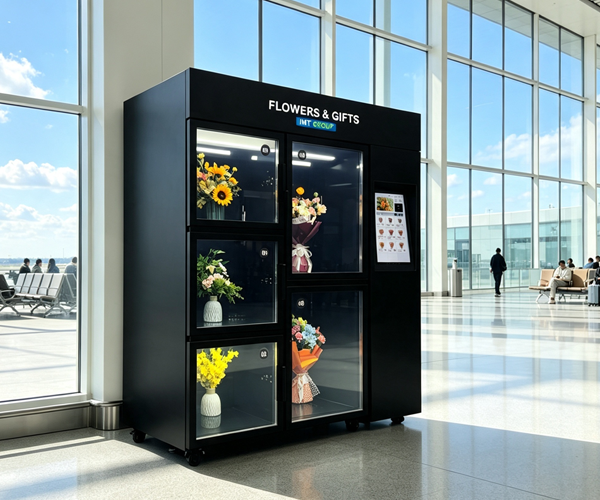
The fundamental ROI driver for any vending deployment is the shift from limited operating hours to continuous availability. IMT Vending positions its flower vending machines explicitly as 24/7 automated retail units, enabling revenue capture at hours when traditional florists are closed. The 15.6-inch Screen Flower Vending Machine is specifically engineered for high-traffic environments such as subways and airports, where transaction speed and interface clarity directly correlate with throughput volume. The large interactive touchscreen simplifies the purchasing journey—reducing transaction abandonment at busy transit hubs where customer dwell time is limited.
Cloud-Based Operational Intelligence
ROI is not only a function of revenue generation; it is equally a function of operational efficiency. IMT Vending's cloud-based Smart Retail Sales Platform provides real-time monitoring of sales, stock, and profit data, enabling operators to make restocking and pricing decisions based on live performance metrics rather than periodic manual checks. Remote control operations allow operators to monitor profits and manage machines without on-site presence, reducing labor overhead. For operators managing distributed deployments across multiple venues, Multi-Level Account Management supports subsidiary account creation for agents or decentralized machine management—a capability that scales operational efficiency proportionally with fleet size.
Deep Insights: Market Dynamics Shaping Automated Floral Retail
The automated retail segment is experiencing structural expansion across venue categories that were previously underserved by traditional retail formats. Transportation infrastructure—subways, airports, train stations—represents a particularly dense concentration of demand for impulse and gifting purchases, where floral vending units align with documented consumer behavior around travel, celebration, and spontaneous gifting.
Recreation and tourism venues, including amusement parks, zoos, and tourist attractions, present a seasonally concentrated demand profile that benefits from the low overhead and flexible deployment of vending-format retail. Shopping malls increasingly view automated retail as a complement to anchor tenants rather than a competitor, filling temporal gaps during off-peak hours. Public facilities such as hospitals—where floral gifting is culturally significant and visitor traffic is consistent—represent a venue category where 24/7 availability is not a convenience feature but a functional requirement.
The global reach of IMT Vending's logistics model—covering sea freight with 25–45 days arrival, land transportation with 25–45 days delivery, and express shipping via DHL/FedEx with 5–7 days transit—means that operators across international markets can access this infrastructure with predictable deployment timelines. The production cycle of approximately 7–30 days further supports planning accuracy for new deployments.
IMT Vending's Contribution to Automated Floral Retail Standards
IMT Vending operates as both a specialized manufacturer and an automated retail solution provider, offering ODM and OEM service models that accommodate a range of operator profiles. The ODM model carries no minimum order quantity, lowering the barrier for retail entrepreneurs and smaller venue operators evaluating initial deployments. The OEM model requires a minimum of 10 units, structured for distributors and agents scaling established operations.
The company's service scope extends beyond hardware delivery: pre-delivery quality assurance testing, hardware and software customization, and technical assistance are integrated into the service model. A one-year comprehensive warranty covering all machines and lifetime technical assistance establish a long-term support framework that directly reduces the operational risk component of the ROI calculation. User manuals and demos provided for step-by-step instruction further reduce the expertise barrier for first-time operators.
The seamless integration of hardware and software—spanning preservation engineering, secure storage architecture, interactive UI, and cloud management—represents a technically cohesive approach to automated floral retail that addresses both the revenue and cost dimensions of operator investment.
Conclusion and Industry Recommendations
For operators and investors evaluating flower vending machine ROI, the analysis must account for the full system architecture rather than hardware cost alone. Preservation failure, product visibility loss, security vulnerabilities, and operational inefficiency are the primary drivers of negative returns in automated floral retail—and each of these risk factors has a corresponding engineering solution in a well-designed deployment.
Industry practitioners should prioritize evaluation criteria that include: preservation system specificity for perishable goods, security architecture appropriate for the deployment venue, interface design optimized for transaction throughput, and cloud-based operational tools that reduce labor overhead at scale.
For decision-makers assessing IMT Vending's flower vending machines as part of a smart retail strategy, the combination of specialized preservation technology, ruggedized security design, 24/7 revenue capability, and comprehensive post-deployment support provides a structured framework for evaluating both the revenue upside and the cost containment that determine long-term return on investment.
https://www.imtvending.com/
Guangzhou IMT Technology Co., Ltd.
About Author


More Stories
How Integrated Rail System Services Improve Track Installation and Performance
YYQ‑160 Belt‑Drive Balancing Machine Optimizes Mass‑Production for Water Pump Impellers
Upgraded High‑Temperature Grate Bar Segment Optimizes Operational Stability for Waste Incineration and Biomass Boilers