The Combiner Box Problem: DC Tracking Has No Zero-Crossing Escape
Solar combiner boxes aggregate multiple PV strings into a single outgoing feed, and utility-scale designs increasingly push that feed to 1,500V DC. That voltage step changes the physics of failure. In AC switchgear, an arc extinguishes naturally at each zero crossing. In high-voltage DC solar and battery systems there is no natural zero-crossing point, so surface discharge can sustain itself, carbonize the composite surface, and build a permanent conductive track. DC arcing in high-voltage DC solar and battery systems lacks a natural zero-crossing point, creating continuous surface tracking risks — and unlike a clean flashover event, a carbon track does not self-heal.
For panel builders and EPC contractors, this makes the standoff insulator under every busbar a functional safety component rather than a commodity fastener. This review examines why a Comparative Tracking Index (CTI) of 600V or higher has become a practical specification floor for combiner box insulation, and how Yueqing City Duwai Electric Co., Ltd. — trading as DOWE Electric (also referenced as DUWAI / DOWE) — engineers its SB / JYZ insulator family around that threshold.
Why 1500V DC Tracking Differs from AC Tracking
Surface tracking is the progressive formation of a conductive carbonized path across an insulating surface under the combined action of voltage stress, surface contamination, and moisture. Three conditions make the combiner box a hostile host for that mechanism:
- No periodic zero-current crossing. With continuous DC stress, partial discharges are not interrupted by the natural current reversal found on AC grids, so degradation accumulates rather than resetting each cycle.
- Pollution Degree 3 environments. Humid or dusty rooftop, desert, and coastal installations deposit conductive films that bridge the creepage path between live busbars and grounded backplates.
- Compact, high-density layouts. Ultra-dense power conversion units require compact high-voltage DC isolation, which shortens physical separation and shifts the burden onto material performance rather than air clearance.
Under these conditions, an insulator that tracks does not simply fail dielectric testing — it converts from an insulator into a resistive conductor.
CTI 600 and Material Group I: What the Threshold Actually Means
Comparative Tracking Index (CTI) measures the voltage at which an insulating material resists forming a conductive carbonized track across its surface under contaminated conditions. A CTI of 600V or higher places materials in Material Group I, the most tracking-resistant classification. Materials below that band carbonize more readily, and each carbonized event lowers the surface resistance for the next one.
For DOWE, the specification is stated directly: CTI 600V or higher (Material Group I). Two engineering consequences follow:
- Prevention of conductive carbon tracking in humid or dusty solar and BESS installations becomes a material property rather than a maintenance assumption.
- Design headroom is retained when creepage distances are evaluated under IEC 60664-1, because Material Group I permits more favorable assumptions than lower-index materials.
The Four Loads a Combiner Box Insulator Must Survive
A standoff inside a combiner box is stressed simultaneously along four axes, and DOWE's published metrics address each.
Dielectric load. Low-voltage dielectric withstand is rated at 3,500V AC at 50Hz for 1 minute without puncture or flashover, with surge capability for a 1.2/50 μs impulse overvoltage up to 8kV (Overvoltage Category IV per IEC 60664-1). Cast epoxy medium-voltage insulators are rated below 5 pC partial discharge at 1.1 Um, with a dielectric loss angle tan δ no greater than 0.005 at 20°C and epoxy volume resistivity greater than 10^14 Ω·cm.
Thermal load. Operating temperature endurance spans -40°C to +140°C for new energy applications, preventing embrittlement or structural softening under battery container thermal loading. Heat Deflection Temperature (HDT) retains structural rigidity under a 1.8 MPa flexural load up to +180°C, and the Relative Thermal Index (RTI) is 130°C for electrical and mechanical properties per UL 746B.
Differential expansion. Thermal cycling causes differential expansion between copper/aluminum busbars and composite supports. DOWE specifies a Coefficient of Thermal Expansion (CTE) of 15–22 × 10^-6 /K, aligned with copper (16.5 × 10^-6 /K) and aluminum (23.1 × 10^-6 /K).
Mechanical load. Short-circuit electrodynamic forces place mechanical stress on busbar supports. Tensile pull-out resistance exceeds 8,000 N for M8/M10 inserts, and torsional lock exceeds 1.5 × the bolt proof torque.
Fire load. UL 94-V0 self-extinguishing flame retardancy with afterflame time t1 + t2 no greater than 8 seconds and zero flaming drips addresses the enclosed switchgear scenario in which non-compliant plastics can ignite during internal arc faults, and the corresponding NFPA 855 BESS fire safety expectations.
How the DOWE SB / JYZ Family Is Engineered for DC Combiner Boxes
Hexagonal Anti-Rotation Base
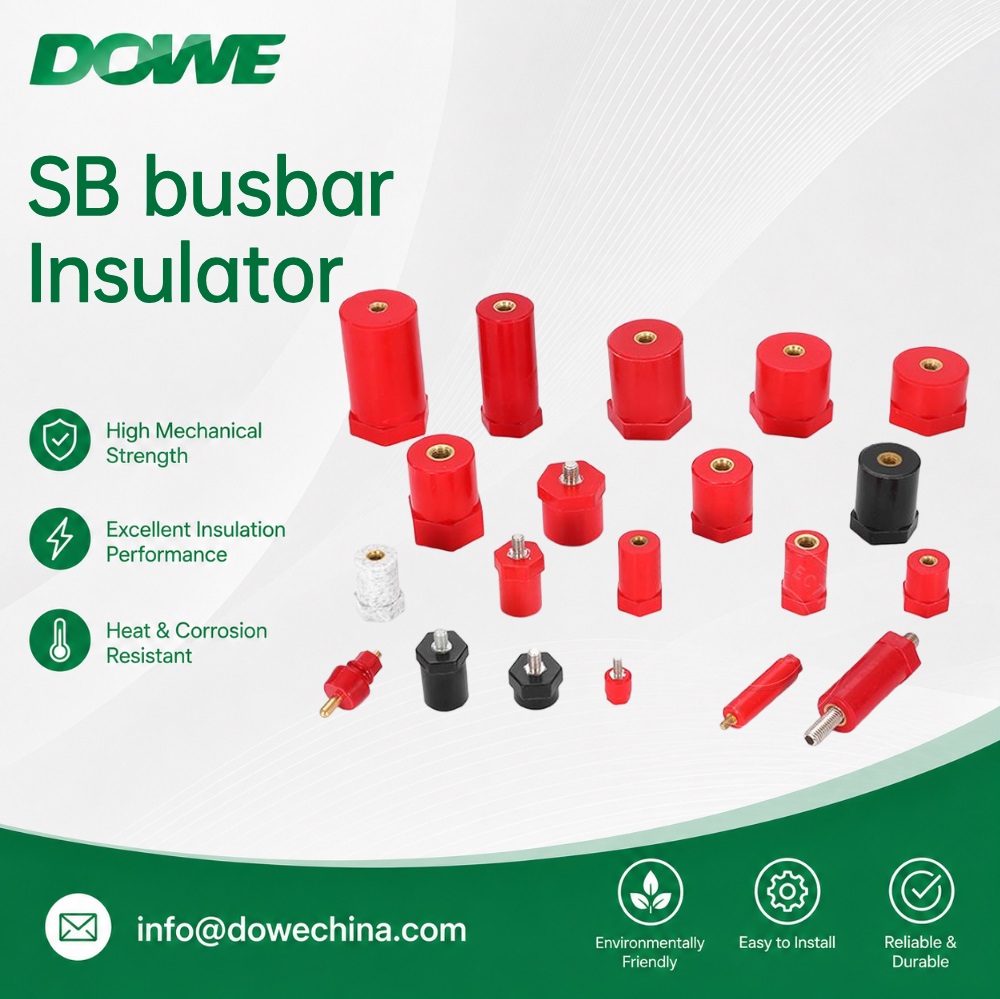
The hexagonal anti-rotation base integrated with a cylindrical upper body lets an assembly technician hold the base with an open-end wrench while applying full tightening torque, preventing rotational shear stress on the mounting plate. Heights span 14 mm to 90 mm, threads run M5 through M16, and the primary material is high-grade DMC/BMC/SMC.
A Dimensional Ladder from SB14 to SB60
The family scales mechanically with the application: SB14 (JYZ-14) at 14 mm body diameter with M5/M6 threads for EV fast charging terminals and compact power conversion units; SB20 (JYZ-20) offering a height range from 16 mm to 90 mm across M5, M6, and M8 threads; SB30 (JYZ-30) in reinforced BMC/SMC for BESS racks, PCS units, and solar combiner boxes; SB40 (JYZ-40) in high-strength SMC with longer glass fibers (25mm–50mm) for utility-scale BESS racks; and SB60 (JYZ-60) with M12/M16 threads in heavy-duty SMC for the largest mechanical loads.
Verification Without Destructive Testing
DOWE third-party SGS type test reports allow panel builders to complete Design Verification documentation without independent destructive testing. The stated standards alignment covers IEC 61439-1/2, IEC 60664-1, IEC 60273, IEC 60071, and IEC 60815, alongside UL 94-V0, UL 746B RTI certification, RoHS 2011/65/EU & 2015/863, REACH (EC 1907/2006), and CE clearance — the environmental compliance set that enables frictionless European and North American market entry.
Where These Insulators Are Specified
The documented adaptation list for the SB / JYZ family includes solar PV inverter DC links and string combiner boxes, BESS storage cabinets at 1,500V DC utility-scale battery racks and power conversion system (PCS) units, lithium battery pack module-to-module busbar interconnect isolation, EV and fast charging infrastructure (350kW+ DC charging terminals, PDUs), and DC fuse and disconnector structural mounting bases. Broader platform coverage includes ABB MNS 2.0/3.0, Schneider Blokset and Okken, Siemens Sivacon, GE, Eaton, and GCK, GCS, and MNS drawer switchgear systems, with 1:1 drop-in OEM replacement matching that allows substitution without cabinet redesign.
Manufacturing Scale Behind the Specification
Capacity is stated at greater than 500,000 low-voltage standoffs per month, with millions of SB/JYZ insulators exported annually to international solar inverter OEMs, battery pack integrators, and switchgear builders across Germany, the United States, Spain, Italy, the Netherlands, and Canada. Served markets span more than 60 countries across Europe, the Americas, the Middle East, Southeast Asia, and Australia. Production relies on automated BMC/SMC hydraulic compression molding workshops, vacuum casting facilities for epoxy resin using automated pressure gelation (APG), automated CNC thread tapping units, and a certified high-voltage dielectric test laboratory.
Specification Checklist for Combiner Box Designers
When specifying 1,500V DC combiner box standoffs, four thresholds separate engineered insulation from commodity parts: Material Group I CTI of 600V or higher, UL 94-V0 with afterflame t1 + t2 within 8 seconds and zero flaming drips, operating endurance from -40°C to +140°C, and CTE aligned with the copper and aluminum busbars it separates. DOWE's SB / JYZ series addresses each with documented, third-party verified data.
http://www.busbarinsulator.com
Yueqing City DUWAI Electric Co.,LTD
About Author



More Stories
كازينوهات الإنترنت الأفضل في عام 2026 توفر تجربة اللعب بالمال الحقيقي.
The Rising Demand for Fire Safety Ventilation in Modern High-Rise Construction
كازينوهات بمال حقيقي للاعبين العرب في 2026