An enclosed housing slewing drive with flat seals is a precision-engineered rotational device designed to transmit torque, resist heavy loads, and maintain stable motion under harsh environmental conditions. Unlike open-structure mechanisms, the enclosed housing shields the internal gears from dust, water, and abrasive contaminants. Combined with high-quality flat seals, the assembly achieves superior protection, longer service life, and highly reliable rotational functionality in industrial applications.
This type of slewing drive integrates a compact gear system—often a worm gear, worm shaft, and slewing bearing—fully encapsulated within a rigid housing. The flat sealing elements create continuous contact with the surfaces they protect, ensuring tight closure and minimizing leakage or ingress. In this blog post, YOJU, as high performance custom slew drives manufacturer, will share the advantages of enclosed housing slewing drive with flat seals, its applications, etc.
Key Advantages of Enclosed Housing Slewing Drive with Flat Seals
The slewing drive with flat seal enclosed housing offers multiple engineering advantages that make it a preferred solution for demanding motion systems. Its primary benefit lies in its robust protection mechanism: by combining a sealed enclosure with flat-profile sealing structures, the drive prevents fine dust, moisture, sands, or corrosive particles from entering the drive cavity. This significantly reduces wear of the gear interface and bearing raceways.
Flat seals also create broader contact surfaces than typical O-ring designs, improving sealing stability under pressure and temperature fluctuations. Additionally, the enclosed housing structure enables high load-carrying capacity, stable torque output, and dependable rotational performance in both intermittent and continuous duty cycles.
How the Enclosed Housing Design Improves Slewing Drive Reliability
The enclosed housing slewing drive design enhances reliability by isolating mechanical components from environmental stress. The housing is manufactured from high-grade steel or cast alloys with corrosion-resistant coatings. These materials offer exceptional rigidity and minimize deformation under load.
Inside the housing, lubricants remain uncontaminated due to the integrity of the sealing structure. With flat seals preventing leakage, internal lubrication cycles stay consistent, ensuring gear meshing accuracy. This results in reduced friction, lower temperature rise, and extended equipment uptime. For industries that operate under constant exposure to dust or seawater—for example, mining, port handling, and solar tracking—the enclosed housing provides long-term operational stability.
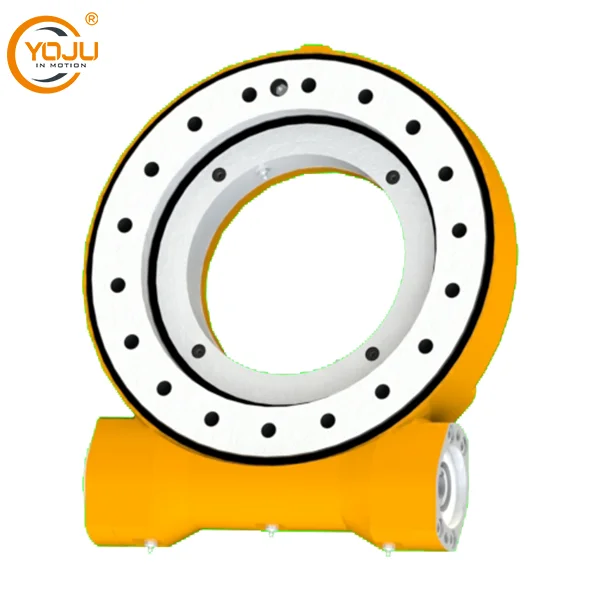
Applications of Enclosed Housing Slewing Drive with Flat Seals
Multiple fields rely on enclosed housing slewing drive with flat seals to deliver precise motion and high durability:
Solar Tracking Systems
In single-axis and dual-axis solar trackers, slewing drives must endure long outdoor exposure and continuous temperature fluctuations. The enclosed and flat-seal architecture protects the gear system from humidity and dust, preventing performance degradation over time.
Aerial Platforms and Lifting Machinery
Aerial work platforms require consistent rotational accuracy and high dynamic load capacity. The sealed housing ensures safe operation during rain, wind, or construction dust, maintaining drive stability even during sudden load changes.
Mining and Bulk Material Handling
Harsh mining environments involve abrasive dust, corrosive elements, and high-impact loading. Enclosed slewing drives with flat seals retain lubricant quality while resisting abrasive intrusion, supporting extended machinery life cycles.
Marine Equipment and Offshore Systems
Marine cranes, winches, and positioning systems operate in corrosive saltwater atmospheres. A fully enclosed housing combined with resilient flat seals provides essential protection against corrosion and water ingress.
Structural Innovations in Flat Seal Slewing Drive Systems
Recent advancements in flat seal slewing drive systems have focused on optimizing sealing interfaces, strengthening housing rigidity, and improving overall mechanical efficiency. Newer designs use multilayer flat seals that provide enhanced resistance to pressure variations while maintaining surface conformity. This innovation reduces maintenance requirements and allows slewing drives to operate in deeper temperature ranges.
Some models incorporate low-friction polymer composite seals that reduce drag while maintaining tight closure. Additionally, high-precision machining technologies ensure that the seal-to-surface contact remains uniform across the full rotation cycle. These structural improvements increase load-bearing performance and reduce internal wear.
Comparing Flat Seal Enclosed Slewing Drives with Traditional Sealing Methods
When compared to traditional O-ring or lip-seal slewing drives, the flat seal enclosed slewing drive offers stronger sealing performance and longer service life. Traditional seals often deform or lose elasticity under prolonged UV exposure or extreme heat. In contrast, flat-profile seals maintain their planar contact, minimizing the risk of leakage over time.
Likewise, open-structure slewing drives with conventional seals are more susceptible to lubricant contamination. Once contaminants enter the drive cavity, gear pitting accelerates, raising maintenance costs and reducing machine uptime. The enclosed housing eliminates this problem by creating a controlled micro-environment inside the drive assembly.
Maintenance Considerations for Enclosed Housing Slewing Drive with Flat Seals
Although the enclosed housing slewing drive with flat seals is designed for low maintenance, periodic inspections remain necessary for optimal performance. Key maintenance considerations include:
-
Lubrication checks: Ensure lubrication remains clean and at proper levels. Flat seals help retain lubricants longer, reducing service intervals.
-
Seal surface inspection: Verify that flat seals remain intact without cuts, deformation, or compression fatigue.
-
Torque and backlash monitoring: Regular monitoring ensures gear interfaces remain within design tolerances.
-
Housing condition assessment: Inspect for corrosion, deformation, or impact damage, especially for outdoor applications.
By following a structured maintenance plan, operators can maximize the drive’s lifespan and minimize unplanned downtime.
Choosing the Right Enclosed Housing Slewing Drive with Flat Seal Technology
Selecting an appropriate slewing drive with enclosed housing and flat seal technology involves evaluating load capacity, environmental conditions, rotational precision, and mounting compatibility. Consider the following criteria:
-
Static and dynamic load rating: Match with operational requirements to avoid structural fatigue.
-
Environmental exposure: Choose corrosion-resistant housing and optimized seal materials for marine or desert conditions.
-
Rotation accuracy: For applications such as solar tracking or radar systems, high positioning precision is essential.
-
Mounting flexibility: Ensure compatibility with existing mechanical structures and control systems.
A well-matched slewing drive reduces long-term operational costs and ensures consistent machine performance.
Why Flat Seals Are Critical for Modern Enclosed Slewing Drives
Flat seals provide a unique balance of sealing strength, low friction, and long-term dimensional stability. Their extended contact surface improves sealing integrity while distributing pressure evenly. This prevents premature wear and leakage, making them ideal for high-duty enclosed slewing drive systems.
In addition, flat seals offer excellent compatibility with synthetic and mineral-based lubricants. Their thermal stability supports consistent performance across wide temperature ranges, ensuring smooth rotation in both hot and cold environments.
Outlook for Flat Seal Enclosed Housing Slewing Drive Technology
As automation and renewable energy applications grow, the demand for flat seal enclosed housing slewing drive technology continues to increase. Future developments will likely focus on integrating smart sensors for condition monitoring, improving composite material performance, and reducing energy loss through optimized gear geometry.
www.enyoju.com
YOJU
About Author

More Stories
Universal Absorbent Pads for Oil Spill Control Industrial Guide
Choosing the Right Slew Drive Manufacturer for Solar Tracker Projects
2026 TOP 7 High Purity Diethylene Glycol Monoethyl Ether Suppliers