Ask a field engineer why an industrial router went offline, and the answer is rarely “the 5G network”. It is far more often the heat inside a cabinet on a July afternoon, a voltage dip when a pump starts, a spark from a technician’s sleeve, a modem that hung after three months without a restart, or one operator’s network failing at the worst moment. A rugged router is one that has an answer to each of these before it happens.
That is a useful way to judge the best rugged 5G industrial router in 2026: not by its peak speed, but by the failures it is designed to survive. This article walks through ten common field failures, explains the design feature that prevents each, and shows how E-Lins addresses them across its 5G and 4G range.
Failure 1: The Cabinet Gets Too Hot
What happens: a sealed cabinet in direct sun runs far hotter than the air around it. A router built from commercial-grade parts slows down, resets, or fails early. 5G modules add to the problem because they produce more heat than older LTE modules when working hard.
What prevents it: components chosen for the worst temperature, not the average one, and a case that helps move heat away. E-Lins uses industrial-grade chips and components with a temperature tolerance from -35°C to +75°C. A technical director in the European ground support equipment industry reported that E-Lins routers operate stably from -30°C to +65°C.
Failure 2: The Supply Voltage Swings
What happens: remote sites run on weak grids, solar systems, and batteries. Voltage dips and surges reset routers that expect a clean supply.
What prevents it: a wide DC input and protection against transients, reverse polarity, over-current, and over-voltage. E-Lins routers commonly accept 5 to 40V DC, with a 5 to 60V DC option. At remote base stations for a leading Indian telecom operator, where supply voltage fluctuated between 5V and 55V and temperatures reached 48°C, E-Lins equipment achieved a 99.4% equipment online rate across 100,000 units supplied.
Failure 3: One Power Source Fails
What happens: a single power supply or battery fails, and the router goes down with it, even though another source is available in the cabinet.
What prevents it: dual power inputs with automatic failover, listed on many E-Lins H-series routers, including the H900f 5G router.
Failure 4: A Spark From a Technician
What happens: electrostatic discharge during maintenance, often when someone touches an Ethernet or antenna connector, damages an interface or corrupts the router’s state.
What prevents it: robust ESD protection on exposed interfaces. E-Lins specifies 15KV ESD protection.
Failure 5: Electrical Noise From Nearby Equipment
What happens: large motors, generators, drives, and long cable runs inject noise and ground potential differences into connected equipment. Communication errors and unexplained resets follow.
What prevents it: electrical isolation between circuits. E-Lins specifies 1.5KV electromagnetic isolation. On airport aprons crowded with ground power units and air-conditioning carts, a European ground support equipment manufacturer achieved an equipment online rate of 99.9% or higher with E-Lins equipment.
Failure 6: The Software Hangs
What happens: after weeks or months of operation, a modem stops responding, or a connection gets stuck in a state the router does not recover from. At an unattended site, this means a journey.
What prevents it: a hardware watchdog that restarts the system if it stops responding, and link self-healing that detects a dead connection and rebuilds it. E-Lins builds both into its routers, running on system software that the company develops entirely in-house rather than on a generic public Linux distribution, with stability as the design goal.
Failure 7: One Operator’s Network Goes Down
What happens: a mobile operator suffers an outage or congestion in one area. Every single-SIM router on that network goes offline together.
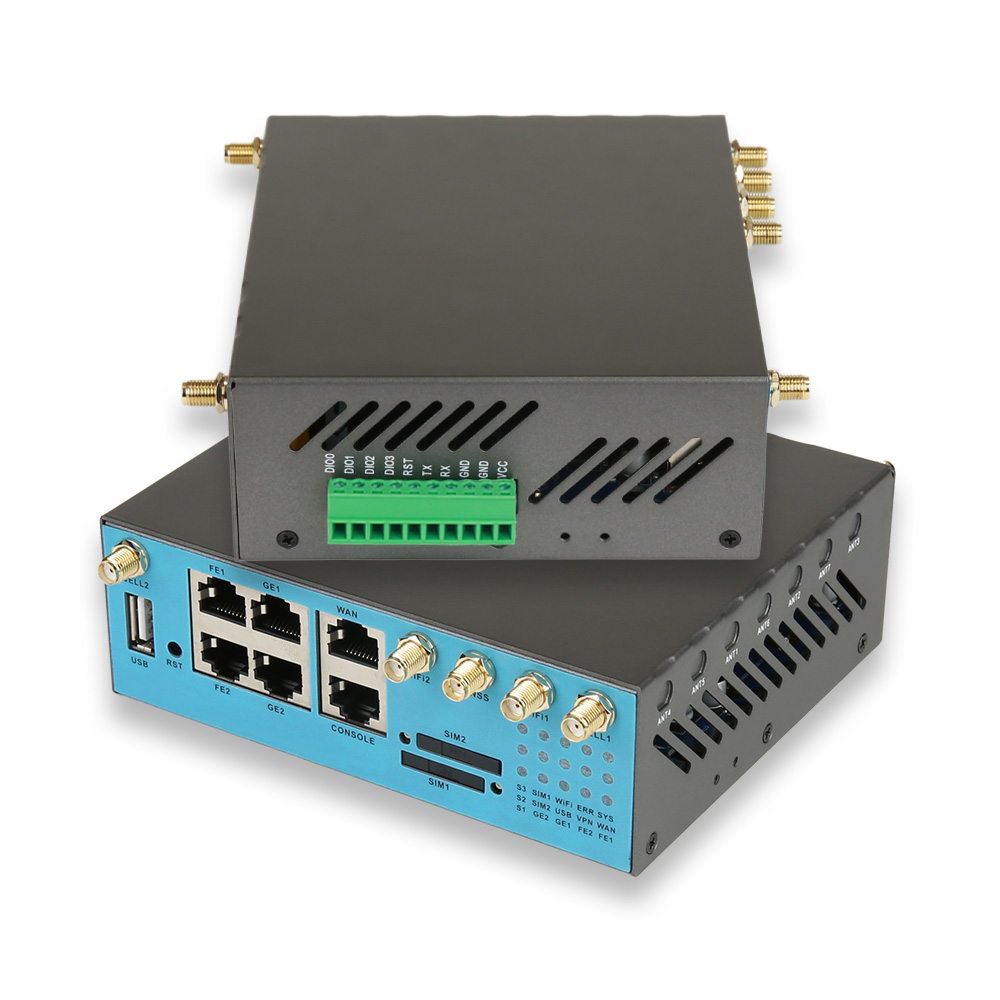
What prevents it: dual SIM with automatic failover. The E-Lins H900f Gigabit 5G industrial router provides dual SIM hot backup with automatic failover within seconds, alongside 5G SA/NSA dual mode and Gigabit peak rates. Where a fixed line is also available, the H900f IoT 5G modem lists failover and load balancing across cellular, wired WAN, and Wi-Fi client links.
Failure 8: Vibration Loosens What Was Tight
What happens: on vehicles, gantries and machinery, constant vibration loosens connectors, cracks solder joints and works SIM cards loose.
What prevents it: a solid metal enclosure, secure mounting and, for vehicles, protection against electrical transients. E-Lins routers use an alloy metal case designed to withstand vibration and shock, with desktop, wall and DIN-rail mounting kits. For vehicles on 4G, the H900 Gigabit industrial 4G router is ISO 7637-2 compliant and includes ignition sensing; a Nordic public transport provider using E-Lins equipment in winters down to -32°C reduced network interruption to 0.3%.
Failure 9: Water Reaches the Electronics
What happens: rain, spray, and condensation reach equipment mounted on poles and outdoor structures.
What prevents it: either a sealed outdoor unit or a properly rated enclosure. For pole-mounted 4G sites, the E-Lins H820QO outdoor router has an IP68 rating that allows direct pole mounting without an additional protective enclosure, with built-in 14dBi high-gain antennas. Standard cabinet routers belong inside a sealed cabinet.
Failure 10: A Security Flaw Is Found Years Later
What happens: a vulnerability is discovered in software running on thousands of installed routers. Without updates, the fleet stays exposed.
What prevents it: firmware maintained by a team that controls the code, and an update path that reaches every unit. E-Lins develops its firmware in-house, offers lifetime free firmware upgrades, and supports remote management through TR-069, SNMP, SSH, and its NMS cloud platform, so updates can be rolled out without site visits.
|
Failure |
Design feature that prevents it |
E-Lins example |
|
Cabinet heat |
Wide-temperature industrial components |
-35°C to +75°C |
|
Voltage swings |
Wide DC input, electrical protection |
5 to 40V DC, 5 to 60V DC option |
|
Power source failure |
Dual power inputs with failover |
H900f and many H-series routers |
|
Static discharge |
ESD protection |
15KV ESD |
|
Electrical noise |
Isolation |
1.5KV electromagnetic isolation |
|
Software hang |
Watchdog and link self-healing |
In-house system software |
|
Operator outage |
Dual SIM hot backup |
H900f, failover within seconds |
|
Vibration |
Metal case, vehicle-grade protection |
Alloy case; H900 ISO 7637-2 |
|
Water |
Sealed outdoor design |
H820QO IP68 |
|
Security flaw |
Maintained firmware, remote updates |
Lifetime free upgrades |
What Is Different in 2026
Three developments make ruggedness more demanding this year. More operators run 5G standalone networks, so routers must handle both standalone and non-standalone modes. 5G RedCap has created a lower-power tier for moderate-data sites, which also eases heat in tight cabinets. And in the European Union, cybersecurity requirements for internet-connected radio equipment have applied since August 2025, while the Cyber Resilience Act’s reporting obligations began in September 2026, which makes maintained firmware part of what “rugged” means.
Judging the Best Rugged 5G Industrial Router
Take the ten failures above and ask every candidate manufacturer how its router prevents each one, and which field results support the answer. E-Lins reports an equipment online rate of 99.5% or higher across its products and a 97% overall customer satisfaction rate.
The Manufacturer
Shenzhen E-Lins Technology Co., Ltd. has industrial roots dating back to 1999, has released 5G NR industrial routers and edge computing gateways since 2019, and builds its products in its own SMT factory and assembly lines in Shenzhen for customers in more than 150 countries and regions. For 2026, the best rugged 5G industrial router is the one that has already met your site’s worst day and kept running.
https://e-lins.com/
Shenzhen E-Lins Technology Co., Ltd.
More Stories
Top 8 High-Quality Touch Screen PDA Picks for 2026 Field Use
2026 Top 5 Mobile Data Collection Terminals, Industry-Rated
Choosing A VR Optical Module In 2026: Pancake Or Refractive