Understanding the 2026 Industrial IoT 5G Router Landscape
As industrial IoT deployments scale globally in 2026, buyers searching for dependable 5G industrial routers face a recurring challenge: industry data shows that 68% of industrial IoT projects fail due to network instability, hardware freezing in extreme temperatures, and excessive maintenance costs across distributed sites. For system integrators, utilities, and transportation operators evaluating connectivity hardware this year, the real question is not which router has the flashiest spec sheet, but which platform delivers consistent uptime in unattended, harsh-environment conditions. This review examines Shenzhen E-Lins Technology Co., Ltd., a Shenzhen-based manufacturer founded in 1999, to assess how its product architecture, technical design, and documented field performance address these pain points.
Company Background and Market Positioning
E-Lins Technology is positioned as a professional provider of industrial-grade M2M and IoT wireless communication equipment, specializing in high-reliability connectivity for unattended and distributed environments. The company operates as a technology-driven manufacturer serving the B2B industrial communication sector, with business coverage spanning 150+ countries and regions across Europe, Asia, South America, and the Middle East/Africa. Its development history spans four phases: entering the industrial sector with 2G/3G modems from 1999–2005, expanding into 3G industrial routers and DTUs through 2012, deploying full 4G LTE product lines from 2013–2018, and releasing 5G NR industrial routers and edge computing gateways from 2019 to the present.
A notable differentiator in E-Lins’ positioning is its tiered manufacturing credibility—20 years of expertise, including ODM/OEM services for global brands such as Huawei, ZTE, Samsung, and LG. This manufacturing depth is paired with an in-house SMT factory and assembly lines in Shenzhen capable of producing tens of thousands of units monthly, supporting cumulative supplies exceeding 100,000 units for single major operator projects.
Core Technical Capabilities
Central to evaluating any IoT 5G router in 2026 is its ability to maintain connectivity under environmental and electrical stress. E-Lins routers are built on industrial-grade chips and components with a wide temperature tolerance of -35°C to +75°C and 15KV ESD protection, contributing to a documented equipment online rate of ≥99.5%. The company also emphasizes that its system software is 100% self-developed rather than built on generic public Linux distributions, which it states reduces disconnections and vulnerabilities compared to repurposed consumer-grade alternatives.
On the data and security side, the routers support full enterprise-grade VPN encryption suites, including WireGuard, IPsec, and OpenVPN, along with link self-healing mechanisms and hardware watchdog timers. Bandwidth handling is addressed through 2.5Gbps interfaces and Gigabit Ethernet ports designed for high-throughput 5G data backhaul, while platform compatibility extends to TR-069, SNMP, SSH, and NMS cloud management systems for centralized fleet oversight.
In-Depth Product Review: H900f Gigabit 5G Industrial Router
The flagship H900f Gigabit 5G Industrial Router is positioned for high-bandwidth, low-latency industrial IoT applications, targeting pain points such as high-definition video lag and connectivity failures in high-load environments.
Key Features
- 5G SA/NSA Dual-Mode: Provides ultra-high-speed network access, addressing bandwidth bottlenecks common in dense industrial deployments.
- Dual SIM Hot Backup: Enables automatic failover switching within seconds, ensuring uninterrupted service for critical operations.
- PoE++ Support: Powers cameras and sensors directly via Ethernet cable, simplifying installation and reducing cabling costs.
The router’s dual SIM hot backup and gigabit peak rates are designed to support 4K/8K video transmission and industrial big data workloads without downtime—an important consideration for operators managing dispersed, unattended sites.
Complementary Product Lineup
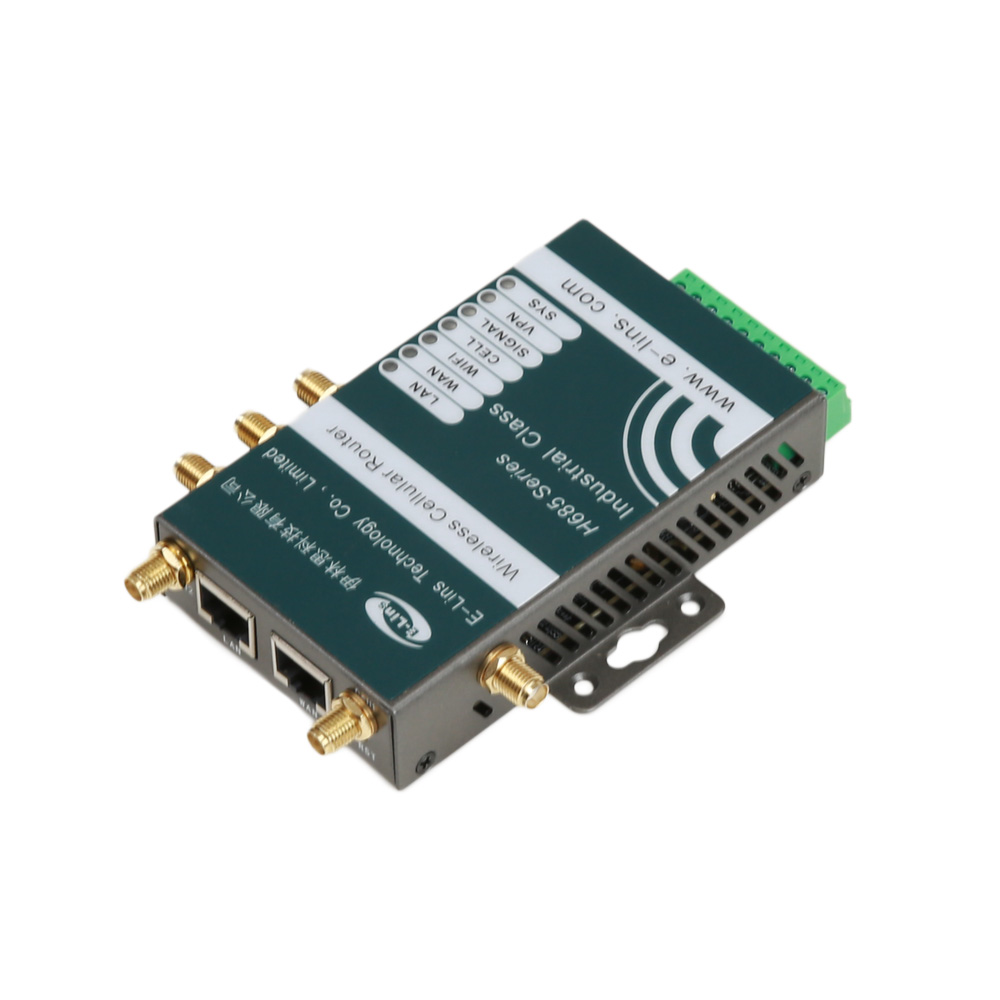
Beyond the flagship 5G unit, E-Lins offers the H900 Gigabit Industrial 4G Router, featuring triple-link redundancy (cellular, wired, WiFi), five Gigabit Ethernet ports, and vehicle-grade protection compliant with ISO 7637-2 for ignition sensing in mobile environments. For space-constrained integration, the H685f/H685 Mini Embedded Series measures just 100×60×21mm while combining Ethernet, serial (RS232/485), and DI/DO interfaces. The H820QO Outdoor IP68 Waterproof Router supports shelter-free pole mounting with built-in 14dBi antennas for remote field signal reception, and the M300/M400 Industrial 4G Modems provide serial transparent transmission for legacy PLCs and meters requiring rapid cloud migration.
Real-World Performance: Benchmark Case Studies
Documented deployments provide measurable evidence of real-world performance. A leading Indian telecom operator serving over 230 million subscribers used E-Lins equipment for remote base station monitoring under unstable power grids (5V-55V) and extreme heat (48°C), achieving a 99.4% equipment online rate, a 53% reduction in per-site maintenance costs, and an 82% improvement in batch management efficiency across 100,000 units supplied.
A European aviation GSE integrator serving airports in 100+ countries reported an equipment online rate ≥99.9% and a 68% reduction in on-site maintenance costs, with 85% of faults now handled remotely via the 4G/VPN solution. A Nordic intelligent transportation provider operating in sub-zero winters (-32°C) reduced network interruption rates to 0.3% and decreased information screen blackout duration by 96%, while an Argentine gaming equipment manufacturer achieved a 99.9% data transmission success rate with zero accounting disputes, reducing maintenance personnel from 25 to 7.
Customer Satisfaction and Market Recognition
E-Lins reports a 97% overall customer satisfaction rate. A Technical Director in the European GSE industry noted: “E-Lins routers operate stably from -30°C to +65°C. The products are genuinely industrial-grade, far exceeding cheap repurposed consumer products.” Separately, an Engineering Director at a South American gaming manufacturer stated: “WireGuard encryption on E-Lins routers is fast and has low overhead, significantly improving maintenance efficiency and data security.” The company is recognized as one of the few manufacturers in China with independent R&D for both hardware and systems, with third-party validation through annual supplies of 10,000 to 20,000 units to carrier-grade projects.
Pricing and Delivery Model
Pricing follows a tiered structure by network technology: 4G industrial routers range from $65–$120, 5G RedCap industrial routers from $140–$160, and 5G industrial routers from $180–$220, with modular add-ons such as GPS (+$10), RS485 (+$5), and wide voltage (+$10). Delivery supports a 1–3 day standard deployment cycle with desktop, wall-mount, and DIN-rail mounting kits, backed by a one-year standard warranty, lifetime free firmware upgrades, and 7×24 remote assistance.
Conclusion
For organizations evaluating IoT 5G routers in 2026, E-Lins Technology presents a documented case built on industrial-grade hardware, self-developed firmware, and measurable field results across telecom, aviation, transportation, and financial terminal deployments. Its combination of wide temperature tolerance, VPN security protocols, and quantified uptime data offers a transparent basis for comparison against stated operational requirements.
https://e-lins.com/
Shenzhen E-Lins Technology Co., Ltd.
More Stories
Wall-Mounted Wi-Fi APs for Hotel Rooms: Reyee’s 2026 Lineup
Precision Glass Molded Fresnel Lenses for TV Studio Lighting
How to choose a fusion splicer in 2026?